Warden
Decide whether a dependency is safe to install — from what its code does, where it came from, and what is known about it.
Warden analyses PyPI packages, project manifests and container images without running them. It
reports what a package does (install hooks, network and process behaviour, obfuscation, credential
access), where it came from (provenance, maintainers, dependency confusion) and what is known about
it (OSV, CISA KEV, FIRST EPSS), and turns that into an allow / warn / block decision under a
versioned policy.
What you can do with it
| Gate dependencies in CI | warden gate -r requirements.txt fails the build on blocked packages; the GitHub Action uploads SARIF to code scanning. |
| Scan a project | Manifests become findings, a dependency graph with blast radius, and CycloneDX / SPDX SBOMs. Dockerfiles and Compose files are linted too. |
| Compare releases | See what changed in behaviour between two versions of a package before you upgrade. |
| Check container images | Analyse a docker save archive offline: user, secrets, installed packages, set-uid binaries, and known vulnerabilities through Trivy. |
| Watch packages | The monitoring worker checks new releases and raises events on drift or maintainer changes. |
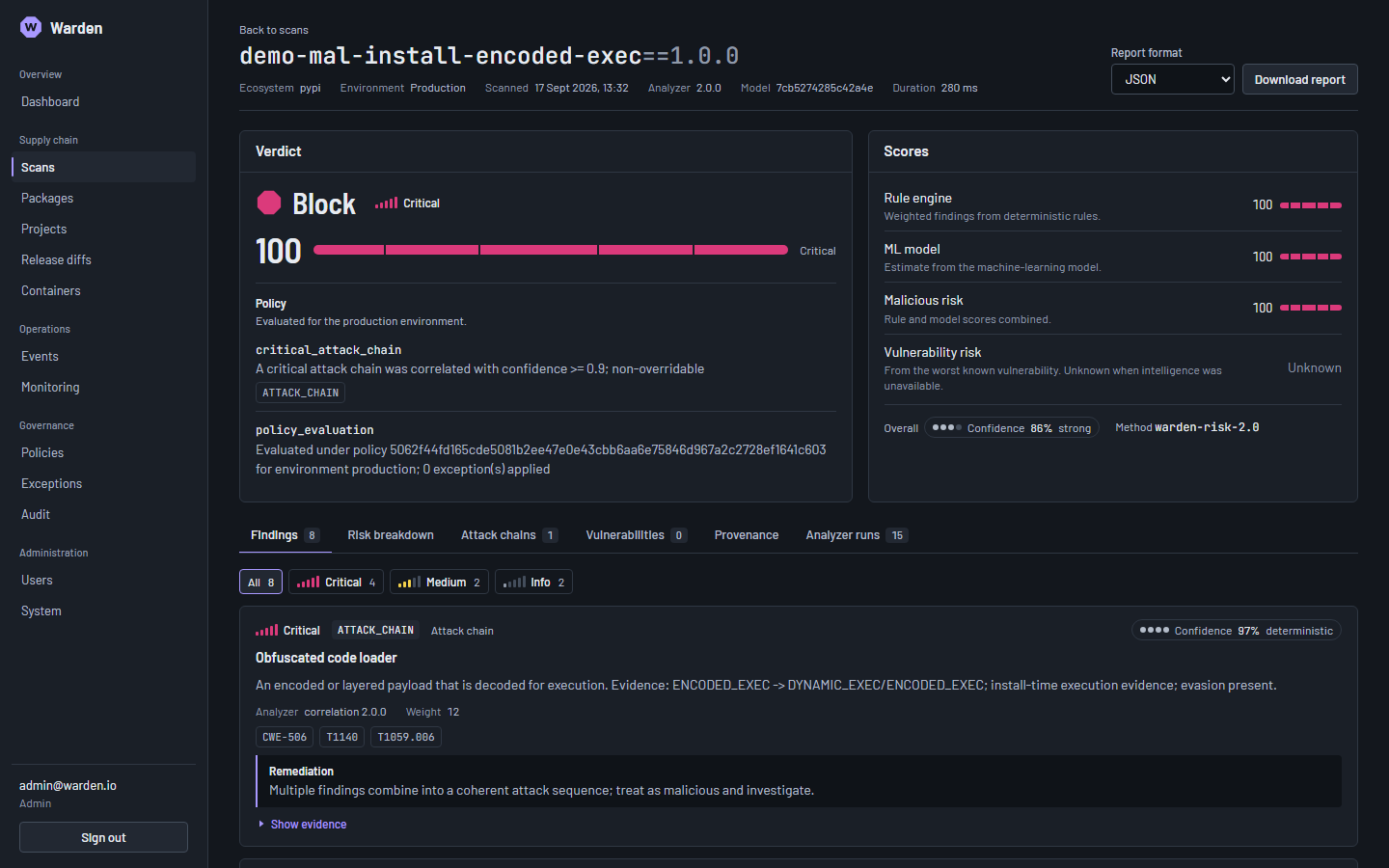
| Investigate | The security console shows findings with file and line, ATT&CK and CWE mappings, attack chains, the audit trail and security events. |
Honest limits
Static analysis reduces risk; it does not certify safety. The detection benchmark is a small synthetic regression baseline, not a real-world detection rate, and the ML model's influence is deliberately bounded (ML model).
Next: Getting started.