How it works
One rule's life in ANVIL, step by step. Every step is a CLI command and a CI gate.
1. Lint
anvil lint --rules rules parses each Sigma rule, checks the condition grammar, modifiers,
regexes, ATT&CK tags and required metadata, and emits finding codes (A1xx). Drafted rules
must carry reviewed: true; otherwise A114 blocks them (the human review gate, ADR 0004).
2. Route and index
Each rule's logsource is mapped to concrete channels and event IDs (anvil/logsource.py,
ADR 0002; ADR 0007 adds Linux and AWS). Events are indexed by (channel, EventID), so a
rule is only evaluated against events it can apply to. On an 1,800-event benign sample this
turns 5.15M candidate rule-event evaluations (2,861 rules x 1,800 events) into about 44k;
Evaluation compares the alerts with routing on and off in the same engine.
3. True-positive replay
SigmaHQ's own regression captures (one JSON capture per rule) are replayed through the engine: a rule passes when it matches its capture. This is a recall check on the development set, not a fidelity proof; the OpenSearch cross-check in CI (see Evaluation) tests the same rules in a real backend.
4. Benign replay and the alert budget
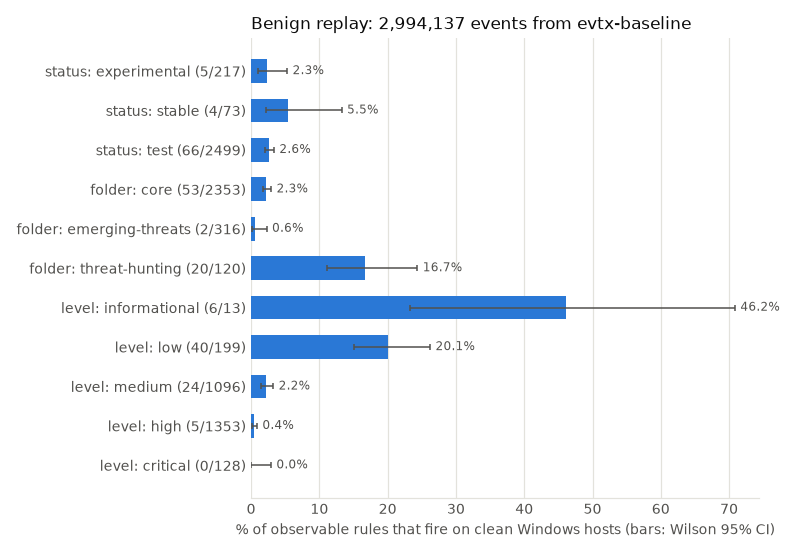
Three clean evtx-baseline hosts are replayed against every observable rule. Hits are converted to alerts per host-day and compared with a budget of 20/day (10% of a 200-alert/day SOC). Rules over budget fail the gate; the fleet-size table in Evaluation shows how the blocked count grows with the number of hosts.
5. Draft, then review
anvil draft REPORT.md extracts command lines from a CTI report and writes candidate
rules to drafts/. They fail lint until a human sets reviewed: true.
6. Decay monitoring
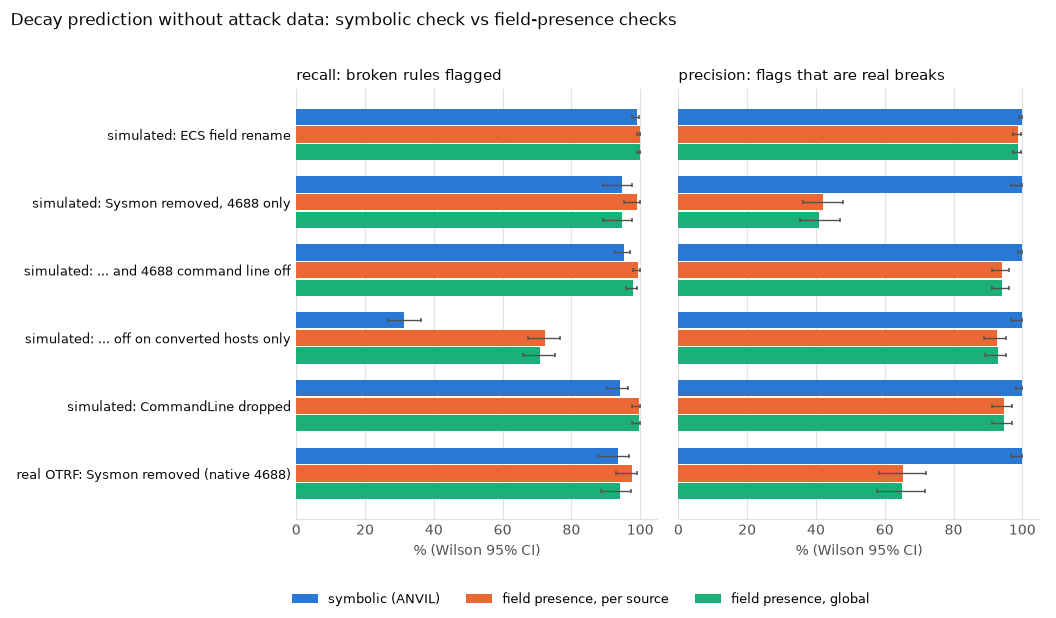
When telemetry changes (a Sysmon-to-4688 migration, an ECS rename, a collector dropping a
field), anvil decay checks every rule's condition for satisfiability against the
observed per-source field inventory, with no attack data. Evaluation compares this with
field-presence (schema-style) validation and with replay ground truth: simulated changes
applied to SigmaHQ's regression captures, and a real one, OTRF captures replayed with and
without their Sysmon channel. A weekly workflow (decay.yml) runs the check and opens an
issue when a rule can no longer fire.
7. Claimed vs validated coverage
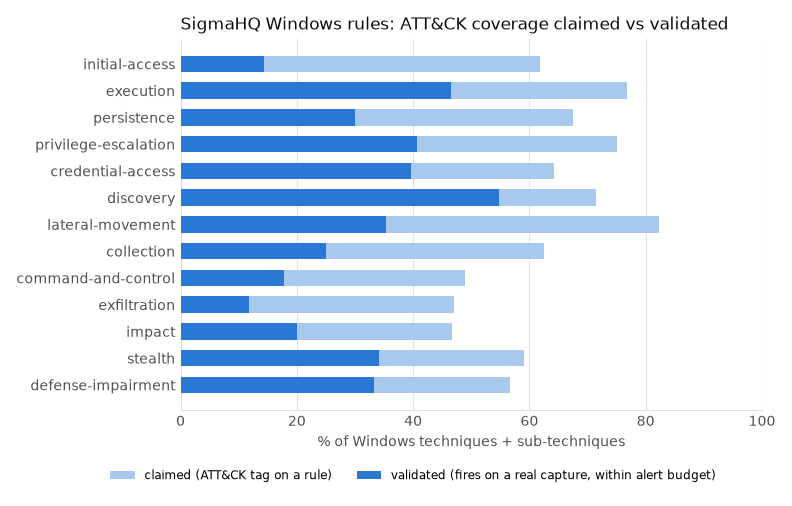
ATT&CK coverage is reported twice: claimed by tags, and validated by rules that actually fired on real captures and passed the budget.