GAUNTLET
GAUNTLET measures ATT&CK detection coverage instead of inferring it from rule tags. It replays four recording sets from two public providers (OTRF and Splunk attack_data) and live, event-labelled auditd telemetry through unmodified SigmaHQ rules. On OTRF, tag-claimed coverage overstates measured coverage by 20.0 points (95% Wilson [11.6, 32.4]): every one of the 55 recorded techniques has a tagged rule at family level, but only 80.0% [67.6, 88.4] are detected. On Splunk attack_data and the OTRF compound campaigns the SigmaHQ release package (medium and above, sigma-all) overstates by 59.0 to 76.9 points (38.5 to 63.6 with the full tag's low-level and hunting rules, sigma-full; the compound sample is 13 techniques). As a control, the Sigma evaluator fires on all 197 SigmaHQ regression samples it runs ([98.1, 100.0]).
To our knowledge this is the first measured, interval-bounded gap between tag-claimed and replay-measured SigmaHQ coverage on public recordings plus live telemetry; Virkud et al. (USENIX Security 2024) argue from rule analysis that technique tags do not imply coverage of real threats.
It also ranks techniques by what real ATT&CK groups do (CTI prioritization), turns gaps into the cheapest rules to add, and gates CI on coverage regressions. It uses only public data. Numbers come from benchmark run 37094883465 and live-telemetry run 37092465944 (Evaluation).
-
80.0% [67.6, 88.4]
OTRF techniques with an on-target SigmaHQ detection (55 techniques, 98 recordings; 95% Wilson). 58.2% [45.0, 70.3] are fully detected.
-
+20.0 to +76.9 pts
Tag-claimed minus measured coverage across OTRF, OTRF compound, Splunk Windows and Splunk Linux (release package). Smallest: OTRF 20.0 [11.6, 32.4]; largest: OTRF compound 76.9 [49.7, 91.8].
-
3 of 4 live techniques
Live auditd telemetry on a CI runner, n = 4 (95% Wilson [30.1, 95.4]; run 37092465944, identical outcomes on 4 runs): SigmaHQ with low-level and hunting rules detects 3 of 4 discovery techniques; the release package detects 0. None of 12 Splunk replays of the same techniques is detected.
-
-75.5 steps [-85.0, -65.8]
CTI ordering vs breadth-first: emulations needed to reach 80% of a held-out ransomware actor's techniques (paired bootstrap over 18 held-out groups).
Try it in 60 seconds
python -m venv .venv && . .venv/bin/activate     # Windows: .venv\Scripts\activate
pip install "git+https://github.com/rakshit-737/gauntlet-detection-coverage@v1.1.2"
gauntlet plan --profile ransomware --top 10       # CTI-prioritized emulation plan (offline)
gauntlet predict --observed T1566.001,T1059.001 -k 5
GAUNTLET is not published on PyPI: install from the v1.1.2 tag or the release wheel. The name gauntlet on PyPI belongs to an unrelated project, so do not run pip install gauntlet. Use v1.1.0 or later; the v1.0.0 wheel and image predate the rules-path and bench-output fixes.
-
The loop from CTI to the regression gate, with real outputs.
-
Methodology, every result table, CIs, live telemetry and published comparisons.
-
Exact commands, expected numbers and runtimes.
-
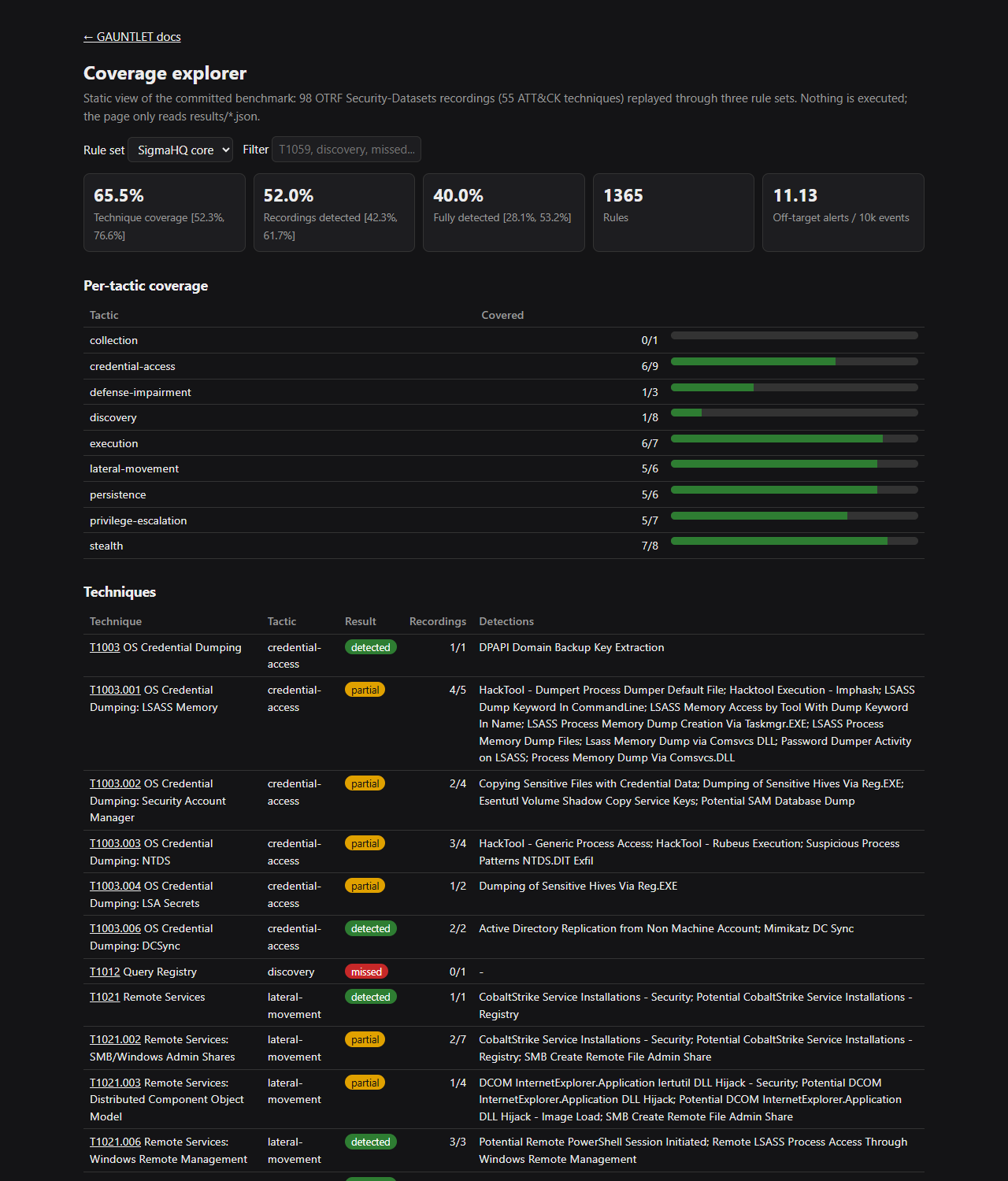
Interactive view of the committed results.
Lab-only
The gauntlet package never executes attack techniques. It reads recorded logs and prints Atomic Red Team test names marked DRY RUN. One CI job runs an allowlist of benign discovery commands (whoami, id, uname -a, ...) on an ephemeral GitHub runner to collect auditd telemetry (ADR 0005). See Security.