How it works
GAUNTLET runs one loop: CTI → prioritized plan → telemetry → detections → coverage → ranked gaps → regression gate. Each stage below shows a real command and its output.
flowchart TB
  A["1. Prioritize<br/>ATT&CK groups to technique ranking"] --> B["2. Plan<br/>dry-run Atomic Red Team manifest"]
  B --> C["3. Telemetry<br/>OTRF / Splunk recordings, live auditd"]
  C --> D["4. Detect<br/>SigmaHQ rules, in-process evaluator"]
  D --> E["5. Score<br/>measured vs claimed coverage, CIs"]
  E --> F["6. Gaps<br/>cheapest wins, telemetry ablation"]
  E --> G["7. Gate<br/>--baseline, exit 2 on regression"]
1. Prioritize: what do real actors do?
attack.py parses ATT&CK Enterprise v19.2 (176 groups, 697 techniques). A threat profile is a set of real groups (for example 18 ransomware groups). prioritize.py ranks techniques by relevance (share of profile groups using it) times prevalence (share of all groups).
gauntlet plan --profile ransomware --top 5
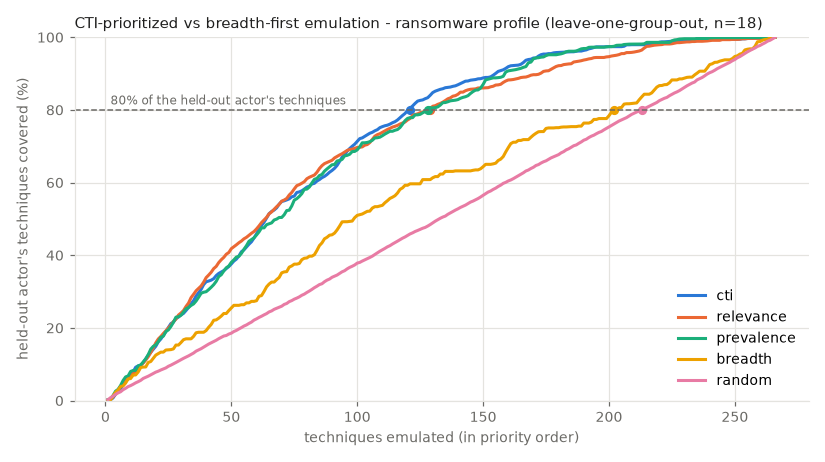
Leave-one-group-out testing shows that this ordering reaches 80% of a held-out ransomware actor's techniques in 118.9 emulations (95% bootstrap [114.3, 123.3]), against 194.4 [185.8, 202.0] for ATT&CK-ID (breadth-first) order. Global prevalence explains most of that gain: see Evaluation.
2. Plan
gauntlet manifest --profile ransomware --top 10 --out plan.json writes Atomic Red Team test names and GUIDs in priority order, marked DRY RUN. GAUNTLET never runs them.
3. Telemetry: recorded and live
| Source | What | Labels |
|---|---|---|
| OTRF atomic | 98 Windows recordings; all but two are labelled with one technique (the others carry 2 and 4) | per recording |
| OTRF compound | 7 multi-technique LSASS campaigns | per recording |
| Splunk attack_data | 552 recordings with Windows XML and Linux (Sysmon, auditd) files; each file is scored with its platform's rules | per recording |
| Live auditd (CI) | allowlisted benign discovery commands on a GitHub runner | per event (PID-matched) |
formats.py parses JSON lines, XML event lines and raw auditd. It merges SYSCALL + EXECVE + CWD records into process-creation events so that Linux process_creation rules can run on auditd.
4. Detect
sigma.py evaluates SigmaHQ YAML directly: the full condition grammar, more than 20 modifiers, and logsource and field mapping for Windows and Linux. Rules are indexed by (channel, EventID). replay.py streams every event through the candidate rules in a process pool and caches the results, keyed by a fingerprint of the rules and the evaluator code.
gauntlet replay --profile ransomware --top 15 --ruleset sigma-core --navigator layer.json --json baseline.json
5. Score: measured, not claimed
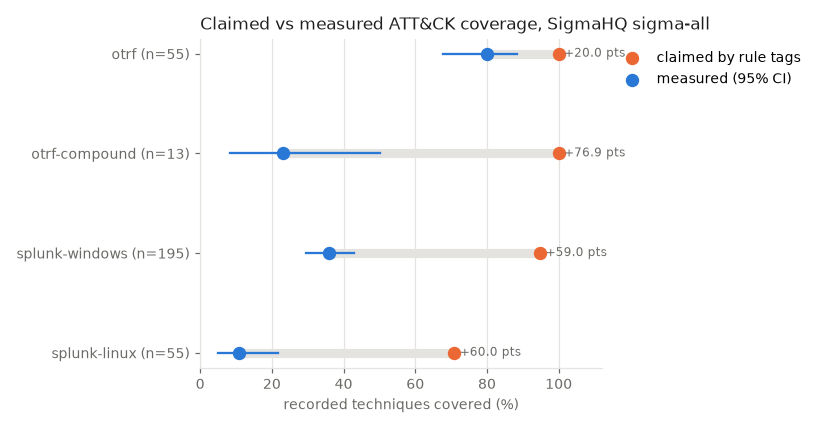
coverage.py counts a technique as covered when a rule tagged with the same technique family fires on a recording of it (on-target). Rules that fire but are not on-target count as off-target alert burden. extended.py compares this measurement with what the rule tags alone would claim:
6. Gaps
Greedy cheapest wins lists the few rules that buy the most threat-weighted coverage. The channel ablation shows which log source each detection depends on. The live job adds one more kind of gap: a rule that matches EXECVE a0 == "whoami" misses /usr/bin/whoami.
7. Gate
gauntlet replay --profile ransomware --top 15 --ruleset sigma-core --baseline baseline.json
echo $?    # 2 if any technique went detected -> missed
The same gate works offline with gauntlet sim --baseline, and CI runs it on every push.