How it works
This page follows one seeded synthetic topology (linchpin synth --family single --hosts 8 --seed 0) through every
stage. Each step names the module that implements it; the figures come from scripts/make_figures.py.
flowchart LR
  A["1. exports"] --> B["2. NormalizedFinding"] --> C["3. versions to CVEs, intel"]
  C --> D["4. attack graph"] --> E["5. k cheapest paths"] --> F["6. chokepoints, exact cut"]
  F --> G["7. plan with evidence"] --> H["8. what-if"]
1. Exports, never targets
LINCHPIN only reads files that already exist: OpenVAS / Greenbone and Nessus XML, nmap -oX (with or without the
vulners script), SharpHound/BloodHound JSON, a topology YAML, or native JSON. A connector per format
(linchpin.connectors) detects the format and parses it with defusedxml. Nothing is ever sent to a host.
2. One schema for every source
Every connector emits the frozen NormalizedFinding contract (contracts/finding.schema.json): kinds cve,
service, credential, acl, config and reachability. Records that fail the schema, or whose kind-specific
detail is unusable (for example a credential without a principal), are dropped and logged. One finding from the
example topology, a vulnerable SSH service on the jump host:
{"finding_id": "308e10ec63c17ab4", "host_id": "jump-01", "kind": "cve", "cve_id": "CVE-2015-4887",
 "cvss_base": 6.0, "cvss_vector": "AV:N/AC:M/Au:S/C:P/I:P/A:P", "epss": 0.01434, "port": 22,
 "detail": {"impact_class": "rce", "kev": false, "cvss_exploitability": 0.68},
 "source": "synth", "observed_at": "2026-01-01T00:00:00+00:00"}
Scanner host ids are merged onto the topology's host ids through the match: lists of the topology YAML, so the
nmap, OpenVAS and BloodHound views of one machine become one node.
3. Versions to CVEs, then exploit intel
When a scan only reports product versions (nmap -sV), linchpin ingest --match-cpe maps them to CVEs offline
with an index of NVD's version ranges (linchpin.intel.cpe, built by scripts/build_cpe_index.py), one finding per
service: the fix is an upgrade. Findings are then enriched from the local NVD / EPSS / KEV cache
(linchpin intel-build): CVSS vector and exploitability sub-score, EPSS, KEV status.
Only vulnerabilities whose CVSS vector implies code execution (network-reachable, integrity High) grant a privilege; KEV entries always do. That gate is why a CVSS 10 information leak does not open a path.
4. The attack graph
GraphStore.build_attack_graph (linchpin.graph.store) turns the findings into a directed graph whose edges point
the way an attacker moves: Internet/Host -CAN_REACH-> Service -HAS_VULN-> Vuln -ENABLES-> Privilege -LEADS_TO-> Host,
Host -STORED_ON-> Credential -GRANTS-> Privilege, Host -HOLDS-> DataStore, plus abusable AD ACLs
(Credential -HAS_ACE-> Ace -ABUSES-> ...). Same-segment hosts reach each other; across segments only the declared
(or, in the CI lab, measured) firewall rules apply.
Every edge carries a deterministic cost in [0, 1], lower meaning easier (contracts/edge_cost.md):
cost = w1 (1 - exploitability) + w2 (1 - prerequisite_match) + w3 skill_penalty (w = 0.5, 0.3, 0.2)
For the SSH vuln above, exploitability = 0.6 x 0.68 (CVSS sub-score) + 0.4 x 0.01434 (EPSS) = 0.4137, so its
ENABLES edge costs 0.5 x 0.5863 + 0 + 0.2 x 0.1 = 0.313. KEV entries are floored at exploitability 0.95, and a
credential whose target is not network-reachable from where it is stored pays prerequisite_match 0.5.
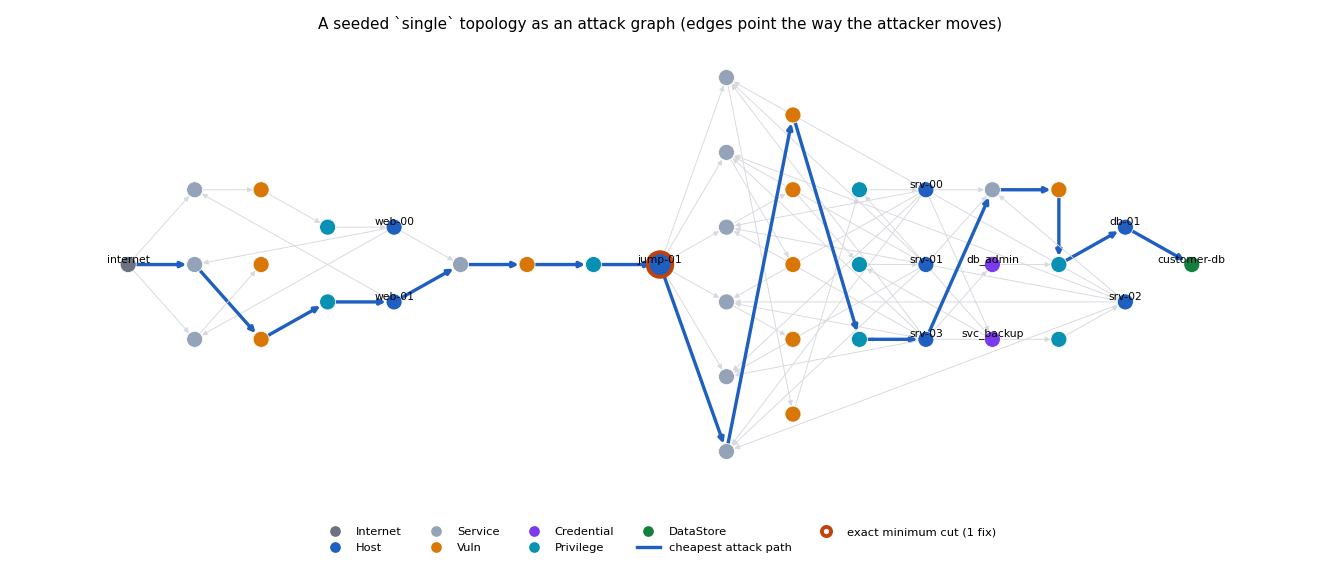
The example graph has 49 nodes and 77 edges (the two unreachable decoy hosts are not drawn).
5. The k cheapest attack paths
GraphStore.k_shortest_paths prunes the graph to nodes that are reachable from an entry point and can reach a crown
jewel, adds a virtual source and sink, and runs Yen's algorithm (networkx.shortest_simple_paths). Each hop gets a
kill-chain stage from its edge type. The cheapest path here, abridged:
internet -> web-01:443 -> CVE-2026-10520 (web-01) -> host web-01 -> jump-01:22 -> CVE-2015-4887 (jump-01)
         -> host jump-01 -> srv-03:445 -> CVE-2022-24165 (srv-03) -> db-01:1433 -> ... -> ds:customer-db
cost 0.592, 17 hops; the next two cost 0.597 and 0.647
6. Chokepoints and the exact minimum cut
linchpin.engine.cuts computes two exact quantities over the remediable nodes (vulns, credentials, ACEs and
non-entry hosts):
- chokepoints: nodes on every entry-to-crown-jewel route, from the dominator tree of the virtual source
(here: the SSH vuln on
jump-01and the hostjump-01itself); - the minimum remediation cut: the fewest fixes that disconnect every crown jewel, from a vertex-split max-flow /
min-cut. With
--weightedit minimises effort instead (a segmentation rule costs 3 patches).
7. A plan with evidence
recommend (linchpin.engine.optimizer) uses the exact cut when it fits the budget and otherwise a greedy set cover
of the enumerated paths, so the plan both disconnects with the fewest fixes when that is possible and keeps a
"most paths broken first" order. Every fix carries a templated rationale (no LLM) and the ids of the paths it breaks:
host:jump-01 (segment mgmt) is the only pivot from dmz to internal; add segmentation rule isolating jump-01 breaks 100/100 enumerated attack paths to ds:customer-db.
8. What-if, and what to do when no cut fits
whatif removes nodes without changing the store: removing host:jump-01 takes the enumerated paths from 100 to 0
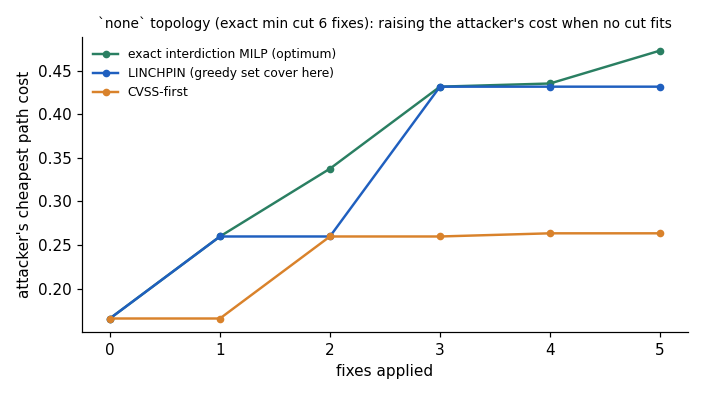
and leaves no crown jewel reachable. When the minimum cut is larger than the budget (the none family needs about
7 fixes), no plan can disconnect, and what matters is how much the fixes raise the attacker's cheapest path. The
figure compares LINCHPIN's fallback with the optimum from the exact interdiction MILP of Israeli & Wood (2002) and
with CVSS-first on one such topology; over 50 seeds LINCHPIN reaches 0.83 [0.77, 0.88] of the optimal rise
(Evaluation).
Outputs
The same engine serves the CLI (linchpin paths / fix / cuts / whatif / node, JSON on stdout), the FastAPI service
and the Cytoscape.js explorer (linchpin serve, localhost only), a Neo4j mirror (neo4j-push, .cypher export) and
the GDS backend for Yen's algorithm inside Neo4j.