How it works
This page follows one bundled input, tests/fixtures/cape/avast_njrat_1.json (a trimmed public Avast-CTU CAPEv2 report of an njRAT sample), through every stage. The full output is the njRAT demo report; run it yourself with python -m specimen report tests/fixtures/cape/avast_njrat_1.json after python scripts/fetch_models.py --only family_. The numbers on this page are generated from docs/demo/summary.json, which scripts/build_demo.py writes with the pinned family model.
flowchart TB
  R["CAPE report"] --> A["Adapter"]
  A --> T["Trace (typed events)"]
  T --> P["Provenance graph + ATT&CK timeline"]
  T --> B["Behaviour scorer"]
  T --> F["Family model"]
  T --> S["Sigma / YARA synthesis"]
  F -.->|"predicted family left out of the negatives"| S
  P --> REP["Report + manifest"]
  B --> REP
  F --> REP
  S --> REP
1. Static gate
A reduced report carries static.pe (imports, sections, imphash), not the sample bytes.
The PE-metadata heuristic scores it 0.2315 (top reason pe_executable +0.80).
For a real PE, analyze still replays every PE; the trained EMBER LightGBM gate is a separate triage-ember command because SPECIMEN has no PE-to-EMBER feature extractor (Evaluation).
2. Adapter to trace
specimen/adapters/cape.py maps behavior.summary (files, keys, mutexes, executed commands, resolved APIs) and full call logs onto one Trace of typed events: process_create, file_write, registry_set, dns_query, net_connect, mutex_create and more. Unknown shapes are ignored; values are coerced to strings and capped; non-finite numbers are refused. Reduced reports have no timing, so events are ordered deterministically and flagged synthetic_ts. Sysmon exports and Speakeasy emulation reports go through their own adapters into the same event model.
3. Provenance graph and timeline
specimen/provenance.py builds the process tree plus file, registry, network, mutex and service edges, and tags events with about 50 ATT&CK rules. The graph of this run, as the report renders it:
flowchart LR
  n0["process: sample.exe (1000)"]
  n1["mutex: bitsperf"]
  n2["mutex: Global\CLR_CASOFF_MUTEX"]
  n3["mutex: 10e93180d6481ad63a77c2b255d40864"]
  n4["mutex: Global\.net clr networking"]
  n5["process: RegAsm.exe (1001)"]
  n6["process: netsh (1002)"]
  n7["file: C:\Windows\WindowsShell.Manifest"]
  n8["file: \Device\KsecDD"]
  n9["file: C:\Users\comp\AppData\Local\Temp\83DFFD621EFA44CF1A60.exe"]
  n10["file: C:\Windows\Globalization\Sorting\sortdefault.nls"]
  n11["file: C:\Windows\System32\UxTheme.dll[.]Config"]
  n12["file: C:\Windows\System32\uxtheme.dll"]
  n13["file: C:\Users\comp\service\svchost.exe"]
  n14["file: C:\Users\comp\AppData\Roaming~ocess for Windows Services.url"]
  n15["file: C:\Users\comp\service\Host Process for Windows Services.vbs"]
  n16["file: C:\Windows\Microsoft.NET\Fram~k\v2.0.50727\RegAsm.exe[.]config"]
  n17["file: C:\Windows\Microsoft.NET\Framework\v2.0.50727\mscorwks.dll"]
  n18["file: C:\Windows\winsxs\x86_microso~e_d08cc06a442b34fc\msvcr80.dll"]
  n19["file: C:\Users"]
  n20["file: C:\Users\comp"]
  n21["file: C:\Users\comp\AppData"]
  n22["file: C:\Users\comp\AppData\Local"]
  n23["file: C:\Users\comp\AppData\Local\Temp"]
  n24["file: C:\Users\comp\AppData\Local\T~3DFFD621EFA44CF1A60.exe.Local\"]
  n25["file: \Device\Http\Communication"]
  n26["registry: HKEY_CURRENT_USER\di"]
  n27["registry: HKEY_CURRENT_USER\Environment\SEE_MASK_NOZONECHECKS"]
  n28["registry: HKEY_CURRENT_USER\Software\10e93180d6481ad63a77c2b255d40864"]
  n29["registry: HKEY_CURRENT_USER\Software\10~0d6481ad63a77c2b255d40864\(kl)"]
  n30["registry: HKEY_CURRENT_USER\Software\Cl~iCache\6\52C64B7E\LanguageList"]
  n31["registry: HKEY_CURRENT_USER\Software\Cl~oot%\system32\dhcpqec.dll,-100"]
  n32["registry: HKEY_CURRENT_USER\Software\Cl~oot%\system32\dhcpqec.dll,-101"]
  n33["registry: HKEY_CURRENT_USER\Software\Cl~oot%\system32\dhcpqec.dll,-103"]
  n34["registry: HKEY_CURRENT_USER\Software\Cl~oot%\system32\dhcpqec.dll,-102"]
  n35["registry: HKEY_CURRENT_USER\Software\Cl~Root%\system32\napipsec.dll,-1"]
  n36["registry: HKEY_CURRENT_USER\Software\Cl~Root%\system32\napipsec.dll,-2"]
  n37["registry: HKEY_CURRENT_USER\Software\Cl~Root%\system32\napipsec.dll,-4"]
  n38["registry: HKEY_LOCAL_MACHINE\SOFTWARE\W~tings\DisableImprovedZoneCheck"]
  n39["registry: HKEY_LOCAL_MACHINE\SOFTWARE\P~et Settings\Security_HKLM_only"]
  n40["registry: DisableUserModeCallbackFilter"]
  n41["registry: HKEY_CURRENT_USER\Control Panel\Mouse\SwapMouseButtons"]
  n42["registry: HKEY_LOCAL_MACHINE\SYSTEM\Con~Control\Nls\CustomLocale\en-US"]
  n43["registry: HKEY_LOCAL_MACHINE\SYSTEM\Con~ntrol\Nls\ExtendedLocale\en-US"]
  n44["registry: HKEY_LOCAL_MACHINE\SYSTEM\Con~ing\Versions\00060101[.]00060101"]
  n45["registry: HKEY_LOCAL_MACHINE\SYSTEM\Con~01\Control\Nls\Locale\00000409"]
  n46["registry: HKEY_LOCAL_MACHINE\SYSTEM\Con~\Control\Nls\Language Groups\1"]
  n47["registry: HKEY_LOCAL_MACHINE\SYSTEM\Con~AccessProviders\MartaExtension"]
  n48["registry: HKEY_LOCAL_MACHINE\SOFTWARE\M~RE_Initialize\DisableMetaFiles"]
  n49["registry: HKEY_LOCAL_MACHINE\SOFTWARE\W~soft\.NETFramework\InstallRoot"]
  n50["registry: HKEY_LOCAL_MACHINE\Software\M~dows\CurrentVersion\SideBySide"]
  n51["registry: HKEY_LOCAL_MACHINE\system\Cur~ontrol\NetworkProvider\HwOrder"]
  n52["registry: HKEY_LOCAL_MACHINE\SOFTWARE\Microsoft\OLEAUT"]
  n53["registry: HKEY_LOCAL_MACHINE\Software\M~rrentVersion\Internet Settings"]
  n54["registry: HKEY_LOCAL_MACHINE\Software\P~rrentVersion\Internet Settings"]
  n55["registry: HKEY_CURRENT_USER\Control Panel\Mouse"]
  n56["registry: HKEY_CURRENT_USER\Software\AutoIt v3\AutoIt"]
  n57["registry: HKEY_LOCAL_MACHINE\System\Cur~olSet\Control\Nls\CustomLocale"]
  n0 -->|"created"| n1
  n0 -->|"created"| n2
  n0 -->|"created"| n3
  n0 -->|"created"| n4
  n0 -->|"spawned"| n5
  n0 -->|"spawned"| n6
  n0 -->|"read"| n7
  n0 -->|"read"| n8
  n0 -->|"read"| n9
  n0 -->|"read"| n10
  n0 -->|"read"| n11
  n0 -->|"read"| n12
  n0 -->|"read"| n13
  n0 -->|"read"| n14
  n0 -->|"read"| n15
  n0 -->|"read"| n16
  n0 -->|"read"| n17
  n0 -->|"read"| n18
  n0 -->|"read"| n19
  n0 -->|"read"| n20
  n0 -->|"read"| n21
  n0 -->|"read"| n22
  n0 -->|"read"| n23
  n0 -->|"read"| n24
  n0 -->|"wrote"| n13
  n0 -->|"wrote"| n14
  n0 -->|"wrote"| n15
  n0 -->|"wrote"| n25
  n0 -->|"set"| n26
  n0 -->|"set"| n27
  n0 -->|"set"| n28
  n0 -->|"set"| n29
  n0 -->|"set"| n30
  n0 -->|"set"| n31
  n0 -->|"set"| n32
  n0 -->|"set"| n33
  n0 -->|"set"| n34
  n0 -->|"set"| n35
  n0 -->|"set"| n36
  n0 -->|"set"| n37
  n0 -->|"read"| n38
  n0 -->|"read"| n39
  n0 -->|"read"| n40
  n0 -->|"read"| n41
  n0 -->|"read"| n42
  n0 -->|"read"| n43
  n0 -->|"read"| n44
  n0 -->|"read"| n45
  n0 -->|"read"| n46
  n0 -->|"read"| n47
  n0 -->|"read"| n48
  n0 -->|"read"| n49
  n0 -->|"read"| n50
  n0 -->|"read"| n51
  n0 -->|"read"| n52
  n0 -->|"read"| n53
  n0 -->|"read"| n54
  n0 -->|"read"| n55
  n0 -->|"read"| n56
  n0 -->|"read"| n57
The timeline rows that carry an ATT&CK technique (every report string is entity-encoded and IOCs are defanged in the Markdown report):
| t | event | ATT&CK |
|---|---|---|
| 0.03 | sample.exe wrote C:\Users\comp\service\svchost.exe | T1105 command-and-control |
| 0.03 | sample.exe wrote C:\Users\comp\AppData\Roaming\Microsoft\Windows\Start Menu\Programs\Startup\Host Process for Windows Services.url | T1547.001 persistence |
| 0.03 | sample.exe wrote C:\Users\comp\service\Host Process for Windows Services.vbs | T1105 command-and-control |
4. Behaviour score
Traces with at least 5 real API calls are scored by the packaged MalbehavD-V1 n-gram LR; reduced reports have no call log, so they get the MVP ATT&CK-feature scorer.
Here the scorer is mvp-synthetic-logreg (ATT&CK features), P(malicious) = 0.9133, driven by n_drop (+2.76), n_persist (+1.18), n_file_write (-0.04). Fused with the static score the verdict is malicious (0.9133, confidence medium (behavior-driven)).
The report always names the scorer used.
5. Family attribution
Events become normalised tokens (user names, GUIDs, SIDs, hex blobs and numbers removed) and a hashed-token LR trained on the Avast-CTU temporal training split predicts the family.
Result for this run: unknown (closest: njRAT), p = 0.821 (avast-ctu-logreg (behaviour+static)). The tokens that drove it: tech:T1105 (+0.230), tactic:command-and-control (+0.225), tech:T1547.001 (+0.214), tactic:persistence (+0.200).
Below the abstain threshold (chosen on a validation slice) the report says unknown (closest: X) instead.
6. Sigma and YARA synthesis
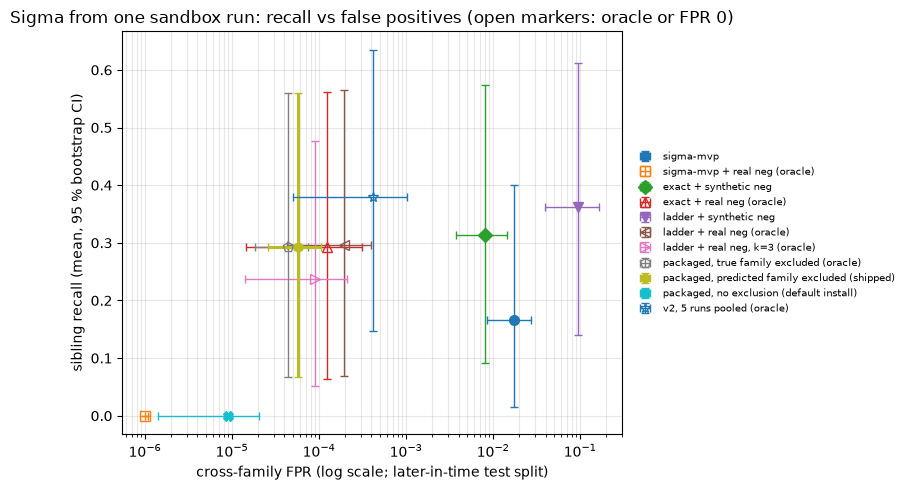
For each host action of the run the synthesiser climbs a generalisation ladder (ADR 0002): rung 0 is the exact value, higher rungs replace user names, numbers, file stems and parent directories with wildcards. A rung is kept only if it still has at least 10 literal characters beyond generic prefixes (hive roots, \Environment, user profile folders) and hits nothing in the negative corpus: the synthetic benign traces plus the packaged Avast-CTU corpus minus the family the model predicted (without a family model nothing is left out). analyze and report use the same synthesizer.
This run yields 10 Sigma rules; the first (generalisation rung 2):
detection:
    selection:
        TargetFilename: 'C:\\Users\\*\\AppData\\Roaming\\Microsoft\\Windows\\Start Menu\\Programs\\*\\Host Process for Windows Services.url'
    condition: selection
Literal segments are escaped for Sigma (\), wildcards are left unescaped, and every value is emitted through a YAML-safe quoter; CI compiles every emitted rule with pySigma and runs it in SQLite on its own run. YARA rules use pe.imphash() or the rarest imports by family prevalence. How far such rules generalise, and what they cost in false positives:
7. Report and evidence manifest
The JSON and Markdown reports carry the verdict with a confidence grade, the static reasons, the timeline, the Mermaid graph, IOCs, rules and a manifest of SHA-256s (sample, trace, report and report content), the negative corpus used (and the family left out) and, for analyze, whether the trace is bound to the sample's hash. In report-only mode no sample bytes are handled: sample_sha256 is taken from the report when present and is otherwise null with a note, and the report file's hash is recorded as report_sha256 / trace_sha256.