How it works
VANTAGE answers one question per ATT&CK technique: is it defended, or only claimed? This page
follows two real techniques through the pipeline, using the synthetic Acme posture
(vantage/postures/acme-real.yaml) on the real catalog: ATT&CK v19.2, the official CIS v8 mapping
and SigmaHQ r2026-07-01. Acme claims CIS IG2, deploys every stable and test Sigma rule, and ingests
only Windows event, cloud, proxy and web logs.
flowchart TB
  C["Claimed control<br/>(CIS / NIST / CTID mapping)"] -- "mitigates" --> T["ATT&CK technique"]
  D["Deployed Sigma rule"] -- "tagged with" --> T
  L["Log source<br/>(ingested?)"] -- "feeds" --> D
A technique is defended only when all three hold: a claimed control maps to it, a deployed rule
is tagged with it, and every log source that rule reads is ingested. Otherwise it is
paper_only (claimed, not detectable), detected_only or blind. "Defended" is detection-backed
coverage: a technique claimed only by a preventive control may still be blocked, so paper_only
means no detection evidence, not exposed.
Every number on this page is computed by benchmarks/bench_walkthrough.py
(results).
Step 1: the claim
The posture says claimed_controls: ["@ig2"]. The official CIS workbook maps 7 IG2 safeguards to
T1055 Process Injection and 14 to T1003.001 LSASS Memory. On paper both are covered, and a
compliance dashboard would colour both green.
Step 2: the rules
SigmaHQ has rules tagged with both techniques, and Acme deploys all stable and test ones. A "coverage by ATT&CK tag" view (DeTT&CT-style, ignoring telemetry) would also call both covered.
Step 3: the telemetry
Each Sigma rule declares a logsource (product/category/service), which VANTAGE turns into a
dependency such as windows/process_creation. Acme does not ingest Sysmon-class endpoint
telemetry, so:
| Technique | claimed by | live rules | dead rules (deployed, log source missing) | most common missing source | status |
|---|---|---|---|---|---|
| T1003.001 LSASS Memory | 14 safeguards | 7 | 61 | windows/process_creation (28) |
defended |
| T1055 Process Injection | 7 safeguards | 0 | 29 | windows/process_creation (12) |
paper_only |
T1055 is "compliant but blind": every rule that could see it is deployed and dead. Across the matrix Acme claims 53.9% of techniques but defends 17.6%, with 2,132 dead rules.
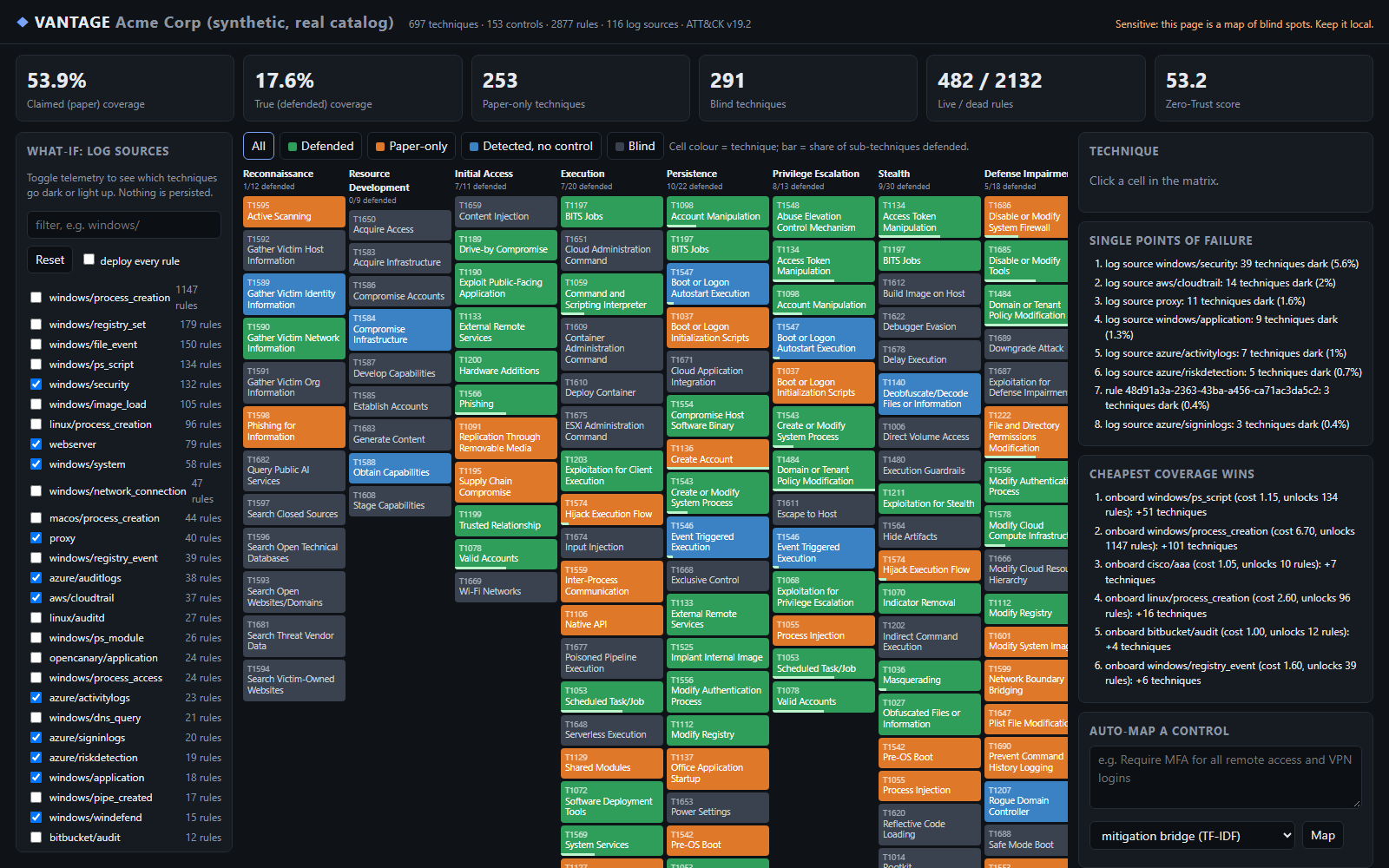
In the UI each cell is a technique, coloured by status. The side panel lists the claiming controls and the live and dead rules with the log sources they need.
Step 4: what breaks, and what to fix first
- Failure propagation removes one node and recomputes. In one pass it ranks every log source
and rule by how many techniques go dark (
vantage failure), and every claimed control by how many techniques lose their only claim (vantage failure --kind control). For Acme, losingwindows/securityblinds 39 techniques. - The recommender runs greedy budgeted set cover over "onboard a log source (and deploy the
rules it unlocks)". Onboarding
windows/ps_script(cost 1.15) unlocks 134 rules and makes 51 techniques newly detectable; defended coverage rises from 17.6% to 22.0% (123 -> 153 techniques, +30), because only claimed techniques count as defended. The recommender maximises newly detectable techniques, not defended ones. On this instance greedy matched an exact ILP at every budget tested (Evaluation).
Step 5: is the gap real or an artefact of one framework?
The ablation repeats steps 1-3 for 12 framework profiles: CIS IG1-3, NIST SP 800-53B LOW/MODERATE/HIGH, CRI Profile, CSA CCM, and the AWS, Azure, GCP and M365 security-stack mappings. It does this at every telemetry tier. The overstatement appears for every framework. With classic Windows logs (T0), most of the gap is missing telemetry (step 3: tagged rules whose log sources are not ingested), in 11 of 12 profiles. Once Sysmon-class endpoint logs are ingested (T2 and up), most of what remains is claimed techniques with no tagged SigmaHQ rule at all (step 2).
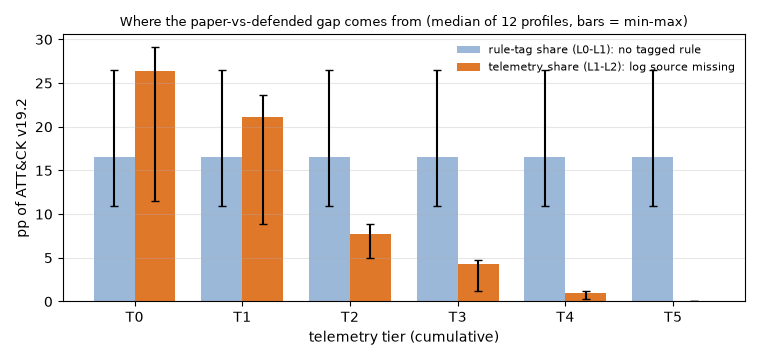
The same page reports a detection-only (DeTT&CT-style) view next to defended coverage, and splits the paper-only techniques by the CIS Security Function of the safeguards that claim them.
Where the mappings come from
Control-to-technique edges come from official public mappings (see Datasets). For a new framework with no mapping, VANTAGE can suggest one: the mitigation-bridge auto-mapper matches control text to ATT&CK mitigations, and the TransferMapper adds labels learned from other frameworks. Both are evaluated in Evaluation and are suggestion tools, not ground truth.