DRAGNET
Evidence-to-actor attribution that says "I don't know" when it should.
DRAGNET turns incident evidence (forensic artifacts and malware feature records) into a
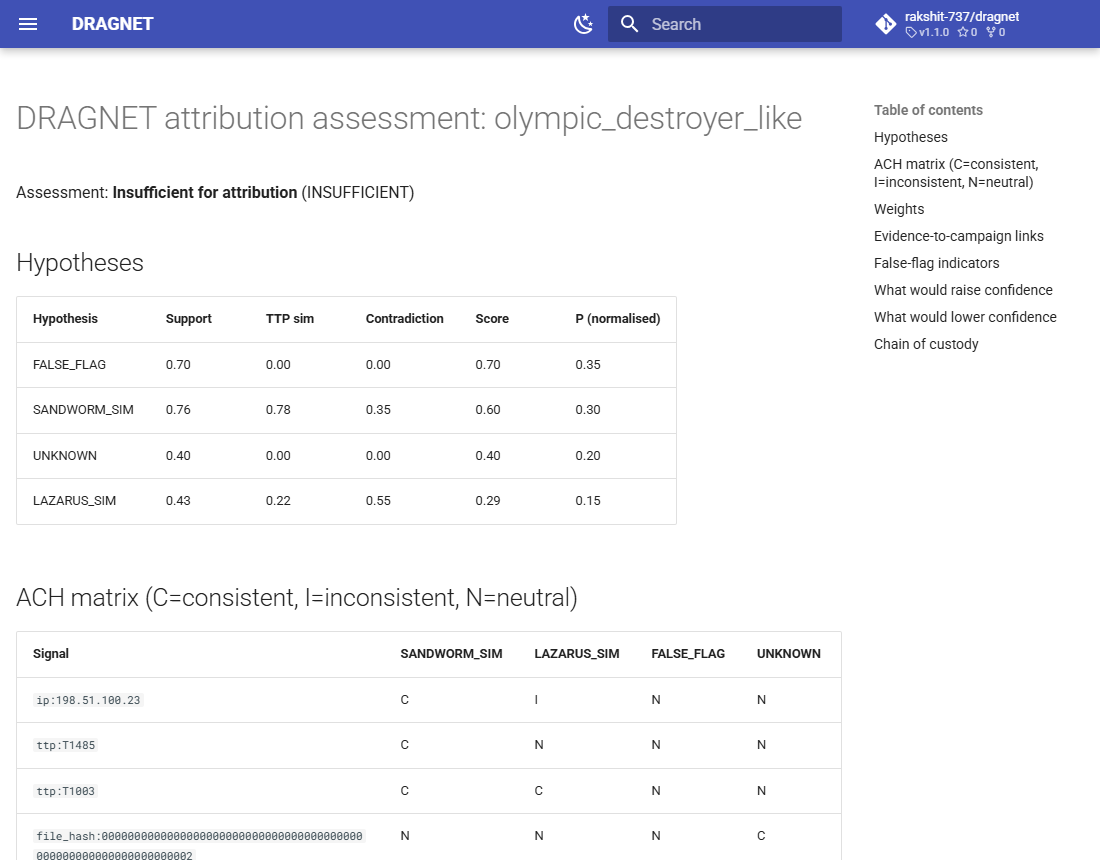
confidence-graded, ACH-audited attribution assessment. It fuses infrastructure, malware genetics,
tooling and ATT&CK techniques into an Analysis of Competing Hypotheses with mandatory FALSE_FLAG
and UNKNOWN hypotheses, a conservative confidence ladder and a hash-chained (optionally
Ed25519-signed) custody log. It is evaluated on real public threat intelligence: MITRE ATT&CK,
MISP galaxy, abuse.ch metadata and APTnotes.
Contribution. DRAGNET fuses tooling and technique evidence (and, when a case has them, host IOCs, imphash/TLSH genetics and infrastructure) with specificity weighting into an ACH that abstains rather than misattributes: on leakage-controlled per-report ATT&CK cases, fusing techniques with software adds +0.095 [0.064, 0.130] top-1 over the same engine on software alone and specificity weighting adds +0.025 [0.003, 0.048]; forgeability-aware false-flag rules cut confident decoy attributions by 0.23 [0.11, 0.37]. The IOC, imphash and TLSH layers are supported inputs whose gain over plain lookups is not shown.
Try it in 60 seconds Evaluation How it works
Headline results
Per-report ATT&CK cases (n = 637 over 161 groups), leave-report-out profiles, 95% CIs bootstrapped over
threat groups. Source: bench run 37092539472 on commit 2d7bacc.
| method | top-1, 5-fold | top-1, temporal 2022+ (n = 219) | names an actor | right when it names one | wrong actor named |
|---|---|---|---|---|---|
| DRAGNET (default engine) | 0.454 [0.401, 0.507] | 0.137 [0.078, 0.214] | 0.429 | 0.853 | 0.063 |
| DRAGNET without the TTP-profile term (ablation) | 0.487 [0.423, 0.541] | 0.126 [0.069, 0.194] | 0.336 | 0.921 | 0.027 |
malware-family count (code-only) |
0.310 [0.251, 0.366] | 0.062 [0.027, 0.107] | 0.323 | 0.913 | 0.028 |
MISP-style software-overlap count (ioc-correlation) |
0.301 [0.245, 0.356] | 0.052 [0.024, 0.090] | 0.349 | 0.788 | 0.074 |
TTP profile, IDF-cosine (ttp-cosine) |
0.218 [0.160, 0.285] | 0.078 [0.034, 0.139] | 0.983 | 0.222 | 0.765 |
TTP profile, Jaccard (ttp-jaccard) |
0.126 [0.084, 0.180] | 0.050 [0.020, 0.091] | 0.936 | 0.133 | 0.812 |
Read the headline with these caveats
- The lead over every baseline is significant with group-clustered sign-flip tests (5-fold Holm p = 5.0e-5, Monte Carlo with B = 200,000; temporal Holm p <= 0.010). MEDIUM verdicts are right 79/83 times (0.95 [0.88, 0.99]).
- The no-TTP-profile ablation scores higher on 5-fold top-1 (0.487 vs 0.454; -0.034 [-0.067, 0.004], two-sided p = 0.088); on the temporal split the default is ahead (0.137 vs 0.126, p = 0.62). Neither is significant; the default is kept for coverage (ADR 0002).
- On the 25 ATT&CK campaigns with their own reports removed, top-1 is 0.40 [0.20, 0.60] and the edge over IOC correlation is not significant (p = 0.25). With a stolen decoy family planted, the false-flag rules cut confident decoy attributions from 0.40 to 0.17 (effect 0.23 [0.11, 0.37]).
| Where to go | |
|---|---|
| Getting started | install, demo, first assessment |
| Architecture | pipeline, scoring, false-flag rules, confidence ladder |
| How it works | one case traced through the pipeline |
| Evaluation | protocol, every number, confidence intervals, published comparison |
| Reproduce | commands, runtimes, expected values |
| Datasets | sources, pins, licences |
| ADRs | design decisions |
| Threat model / Changelog | security model, history |
| Demo reports | static rendered reports + STIX bundles |
| CLI / REST / Python API | reference |
| Limitations | what DRAGNET cannot do |
Attribution is an analytic judgment, not proof
DRAGNET is defensive decision support. Its output must not be the sole basis for public naming, sanctions or any "hack-back". It never downloads, stores or executes malware.