OCCAM¶
Contribution: an open, leakage-controlled benchmark for attack attribution under planted, authentic and mimicked false-flag evidence, plus an auditable ACH engine measured on it. The numbers below include where ACH loses.
Try the live demo How it works Evaluation Preprint (PDF)
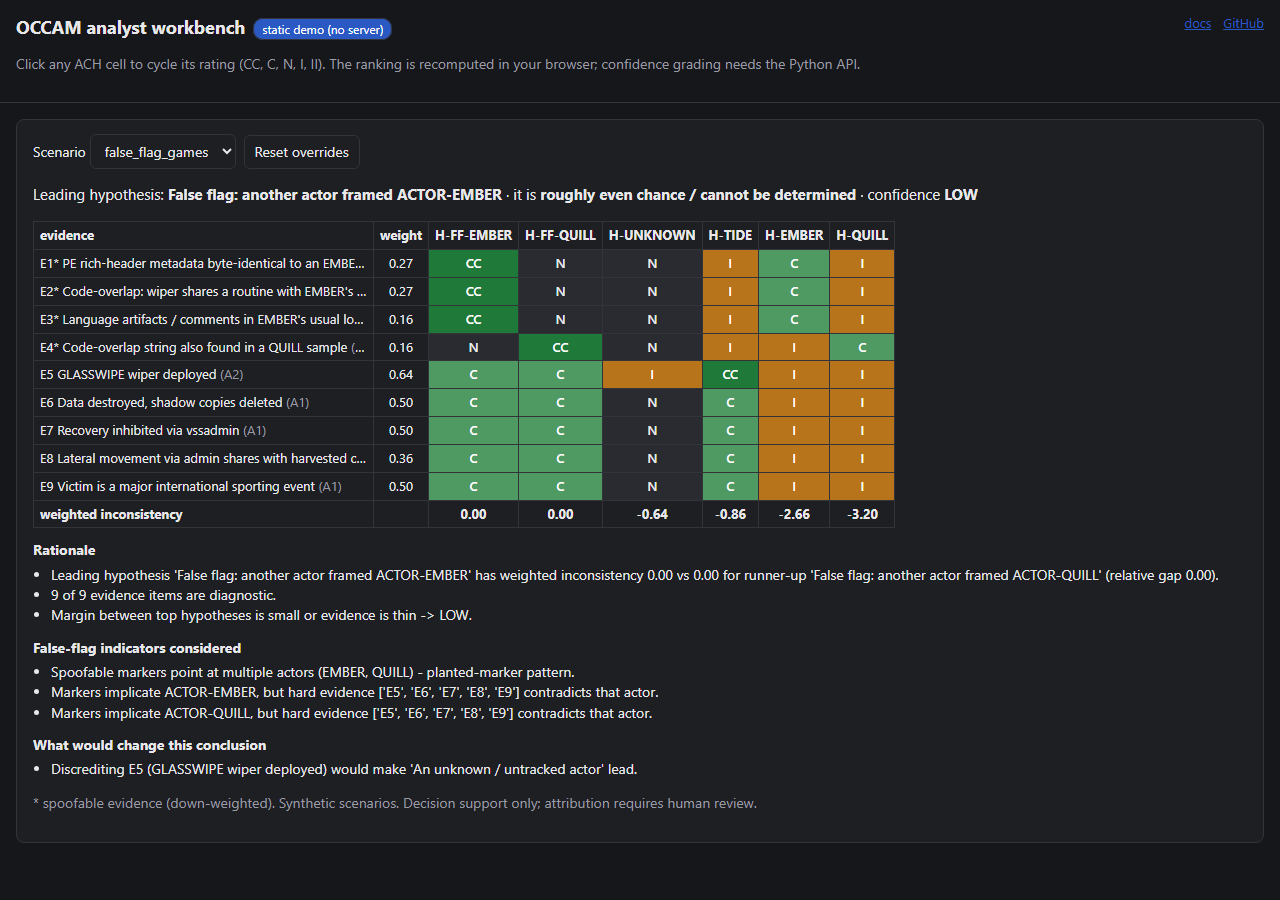
OCCAM extracts ATT&CK techniques, software and IOCs from report prose, and anchors every hit to its source span. It clusters activity into campaigns. It then runs Heuer's Analysis of Competing Hypotheses with mandatory unknown actor and false flag hypotheses. Confidence goes down when the case rests on evidence that is cheap to plant, and an analyst can override every cell of the matrix.
Research question and answer¶
Does automated ACH with mandatory disconfirming-evidence weighting give better-calibrated, less overconfident attribution than naive TTP-similarity matching, especially under false flags?
Mostly no. ACH's remaining advantage is an inspectable matrix with span-anchored evidence. That is a design property and is not measured here.
- Calibration is worse overall. Under one setting-agnostic calibration map, the pooled Brier score is 0.214 for ACH and 0.160 for the marker-trusting similarity matcher (paired difference +0.031 to +0.080, for an equal mix of closed, open and planted-marker incidents). ACH is better only in the closed world.
- Overconfidence. Under planted markers, ACH's capped grades are never wrong at stated p ≥ 0.8 (0/274). The matcher's softmax is wrong at that level 70.8% of the time. After one recalibration, neither method makes such errors (1/822 vs 0/822).
- Planted markers. ACH names the framed group 1.1% of the time, against 88% for the matcher. A baseline that ignores spoofable rows is never framed, and a consistency gate is correct more often.
- Mimicry. ACH is framed less often than IDF coverage (27.0% vs 32.1%) but is correct less often (17.9% vs 28.8%; paired −16.0 to −6.6 points).
- Abstention. An abstaining cosine-threshold baseline declines more on untracked actors at the same closed-world accuracy (93.4% vs 46.0%).
Try it in 60 seconds¶
# browser: https://rakshit-737.github.io/occam-cti-attribution/demo/
docker run --rm -p 127.0.0.1:8000:8000 ghcr.io/rakshit-737/occam-cti-attribution:latest   # http://127.0.0.1:8000/
git clone --depth 1 https://github.com/rakshit-737/occam-cti-attribution && cd occam && python -m pip install -e . && occam demo
Headline results¶
The test set is 274 held-out ATT&CK incidents from 103 groups. Brackets are 95% group-cluster bootstrap intervals. † marks a rate of exactly 0, shown with a Wilson interval that uses the 103 groups as its sample size. Each row links to its result file. All rows come from bench run 37093689060 (commit 09cde53). Full tables and methods are on Evaluation.
| Question | OCCAM ACH | Best simple baseline | Naive TTP-similarity | Source |
|---|---|---|---|---|
| Framed group named, 3 planted spoofable markers | 1.1% [0.0–2.6] | 0% [0.0–3.6]† (ignore spoofable rows) | 88.0% [82.3–93.3] | falseflag |
| Correct under planted markers (true group or detected frame) | 73.4% [66.9–79.6] | 92.0% [88.4–95.2] (consistency gate) | 11.3% [6.4–16.9] | falseflag |
| Genuine markers called a frame-up | 18.6% [13.8–24.4] | 0% [0.0–3.6]† | 0% [0.0–3.6]† | falseflag |
| Framed group named under TTP mimicry | 27.0% [21.3–33.5] | 32.1% [25.4–39.2] (IDF coverage) | 76.3% [70.9–81.8] | falseflag |
| Correct under TTP mimicry | 17.9% [12.2–23.8] | 28.8% [21.9–35.8] (IDF coverage) | 21.2% [15.5–27.0] | falseflag |
| Correct "unknown" when the true group is untracked | 46.0% [39.3–53.1] | 93.4% [90.6–96.1] (cosine threshold matched to ACH's closed-world accuracy) | 0% [0.0–3.6]† | falseflag |
| Closed-world top-1 | 29.9% [22.9–37.1] | 53.3% [45.3–60.8] | 53.3% [45.3–60.8] | falseflag |
| Brier, one setting-agnostic map, three settings pooled (lower is better) | 0.214 [0.202–0.226] | 0.214 [0.203–0.226] (abstaining baseline) | 0.160 [0.141–0.178] (ACH minus it: +0.031 to +0.080) | falseflag |
Extraction and reproduction use their own metrics, so they have a separate table.
| Task | Result | Comparison | Source |
|---|---|---|---|
| rcATT tactic micro F0.5 | released code reproduces 64.82 ± 3.44 | paper: 65.38 ± 2.87 (Table 4) | rcatt_reproduction |
| rcATT technique micro F0.5 (197 techniques) | released code reproduces 36.33 ± 1.39 | paper: 35.02 ± 5.32 (Table 4) | rcatt_reproduction |
| TRAM2 document micro-F1, TF-IDF + LR | 0.710 [0.680–0.738] | keywords: 0.388 [0.329–0.434] | extraction |
The ± values are SDs over 5 folds: they describe spread, not confidence. The TRAM2 brackets are document-bootstrap 95% intervals.
Decision support, lab use only
Attribution has diplomatic, legal and human consequences. Results about real ATT&CK groups are benchmark artefacts, not findings. OCCAM reads text and JSON only; it never contacts infrastructure or downloads malware.