How it works
This page follows one bundled scenario, false_flag_games, from evidence to
conclusion. Every step can be reproduced with
occam ach false_flag_games # or: python -m occam ach false_flag_games
and explored interactively in the live workbench demo, which opens on this scenario.
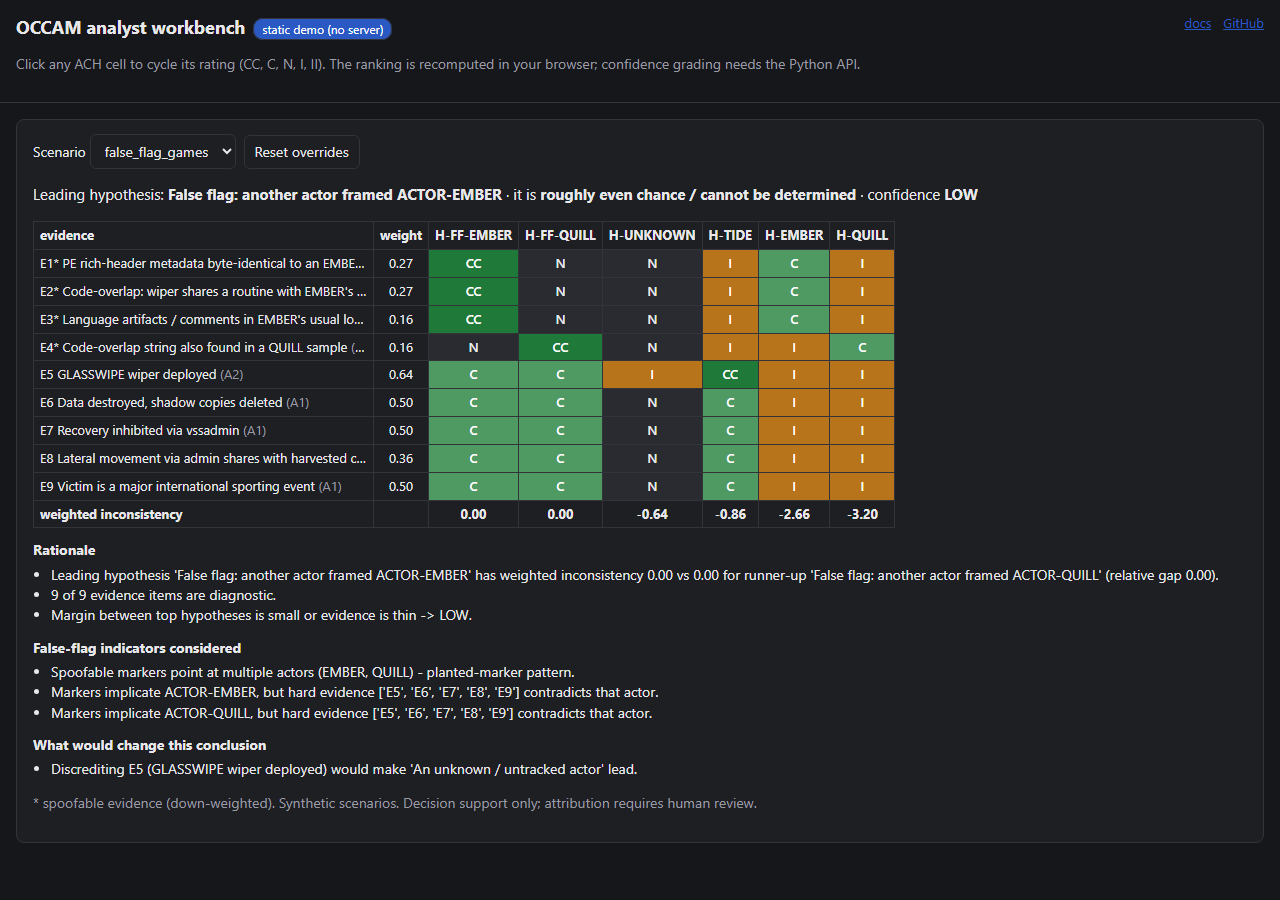
1. Evidence, each with a source and a grade
The scenario has nine evidence rows. Four are spoofable (marked *):
PE metadata, a shared code routine, language artefacts and a second code
overlap. They are cheap to plant, and three of them point at ACTOR-EMBER,
one at ACTOR-QUILL. Five are hard evidence: the GLASSWIPE wiper, data
destruction, recovery inhibition, lateral movement over admin shares and the
victim profile. Every row carries an Admiralty grade (source reliability A-F,
information credibility 1-6), which becomes part of its weight. When evidence
comes from a report, each row also carries the exact text span it was
extracted from (occam extract), so a reviewer can check it.
2. Hypotheses, including the uncomfortable ones
ACH never only asks "which known actor?". OCCAM always adds an unknown / untracked actor hypothesis and, for every actor that a spoofable marker points at, a "false flag: someone framed X" hypothesis. Here that gives six columns: three actors (TIDE, EMBER, QUILL), two false-flag hypotheses (framed EMBER, framed QUILL) and unknown.
3. The matrix: consistency, not similarity
Each cell rates one evidence row against one hypothesis: CC (very
consistent), C, N (neutral), I (inconsistent) or II. The rules propose the
cells, and an analyst can override any of them (click a cell in the
workbench, or --override E5:H-TIDE=I):
- A planted marker pointing at EMBER is C for "EMBER did it" but CC for "someone framed EMBER", because a frame-up predicts exactly that marker.
- Hard evidence that contradicts EMBER (EMBER never used GLASSWIPE) is I for EMBER and C for "someone framed EMBER".
- A technique used by most ATT&CK groups is N everywhere and so carries no weight. On real data, "common" and "rare" are measured from ATT&CK usage.
4. Diagnosticity weights
A row's weight is reliability x credibility x relevance x diagnosticity, where diagnosticity is the spread of its ratings across hypotheses. A row that rates every hypothesis the same weighs 0, as in Heuer's method. Spoofable rows are additionally multiplied by 0.5. In the screenshot the GLASSWIPE row weighs 0.64 and the planted metadata row 0.27.
5. Ranking by least inconsistency
Hypotheses are ranked by how much weighted evidence contradicts them, not by how much supports them. Here both false-flag hypotheses have inconsistency 0.00, unknown -0.64, TIDE -0.86, EMBER -2.66 and QUILL -3.20. Ties go to the more conservative conclusion (unknown, then false flag, then a named actor). The leading conclusion is "false flag: another actor framed ACTOR-EMBER", and the actor the markers point at is ranked near the bottom.
6. Confidence that is allowed to go down
The grade starts from the margin over the runner-up and the number of diagnostic rows, then caps apply:
- LOW if most of the leader's support is spoofable;
- at most MODERATE for deception or unknown conclusions, when a same-actor false flag is not decisively rejected, or when planted-marker indicators fire (markers point at several actors, or hard evidence contradicts the actor they implicate).
Here the two false-flag hypotheses tie, so the result is LOW: it is "roughly even chance" who was framed, and the tool says so.
7. What would change the conclusion
A leave-one-out pass reports which single row, if discredited, would flip the leader. Here, discrediting E5 (the GLASSWIPE wiper) would make "unknown actor" lead, so E5 is the row to re-verify first.
How well does this work on real data?
The Evaluation page measures this machinery on hundreds of held-out ATT&CK incidents, including the cases where it does not help: a simple baseline that ignores spoofable rows resists planted markers just as well, ACH costs closed-world accuracy, and it sometimes mistakes genuine overlap for a frame-up. Under mimicry, where the adversary copies the framed group's rare techniques as hard evidence, it is framed less often than IDF coverage (27.0% vs 32.1%) but is also correct less often than IDF coverage (17.9% vs 28.8%), and the ablation does not attribute that gain to diagnosticity weighting.