How it works
This page follows one real capture through every stage: the committed OTRF
otrf_psexec_lsa_secrets.jsonl fixture (MIT, field-trimmed), in which an operator runs
Sysinternals PsExec to dump the LSA secrets registry hive. Every number below is what
revenant analyze tests/fixtures/otrf_psexec_lsa_secrets.jsonl produces today.
flowchart LR
  A["1 raw rows"] --> B["2 normalised, hashed events"]
  B --> C["3 fusion"]
  C --> D["4 causal rules"]
  D --> E["5 stories + ATT&CK"]
  E --> F["6 confidence"]
  F --> G["7 report + custody"]
1. Raw rows
The capture is JSON lines exported from Windows Event Log (Sysmon, Security, System,
PowerShell). Before anything is parsed, the file itself is hashed and an acquire record is
appended to the custody ledger (sha256 d4dd49a4…9b65, identical on every platform: .gitattributes keeps fixtures byte-exact). A row looks like:
{"SourceName":"Microsoft-Windows-Eventlog","TimeCreated":"2020-10-19 03:30:41.104",
 "Hostname":"WORKSTATION5","Channel":"Security","EventID":1102}
2. Normalised, hashed events
The parser maps 126 of the 156 rows onto the actor-action-object schema and reports the
rest as unmapped (they appear in the report's "What remains uncertain" section). Each event
gets a content hash, and its id is derived from it. Collector-local clock fields are
corrected per capture (ADR 0007): the row above was written at 03:30 collector time,
which is 07:30 UTC.
| event | time (UTC) | source | actor → object |
|---|---|---|---|
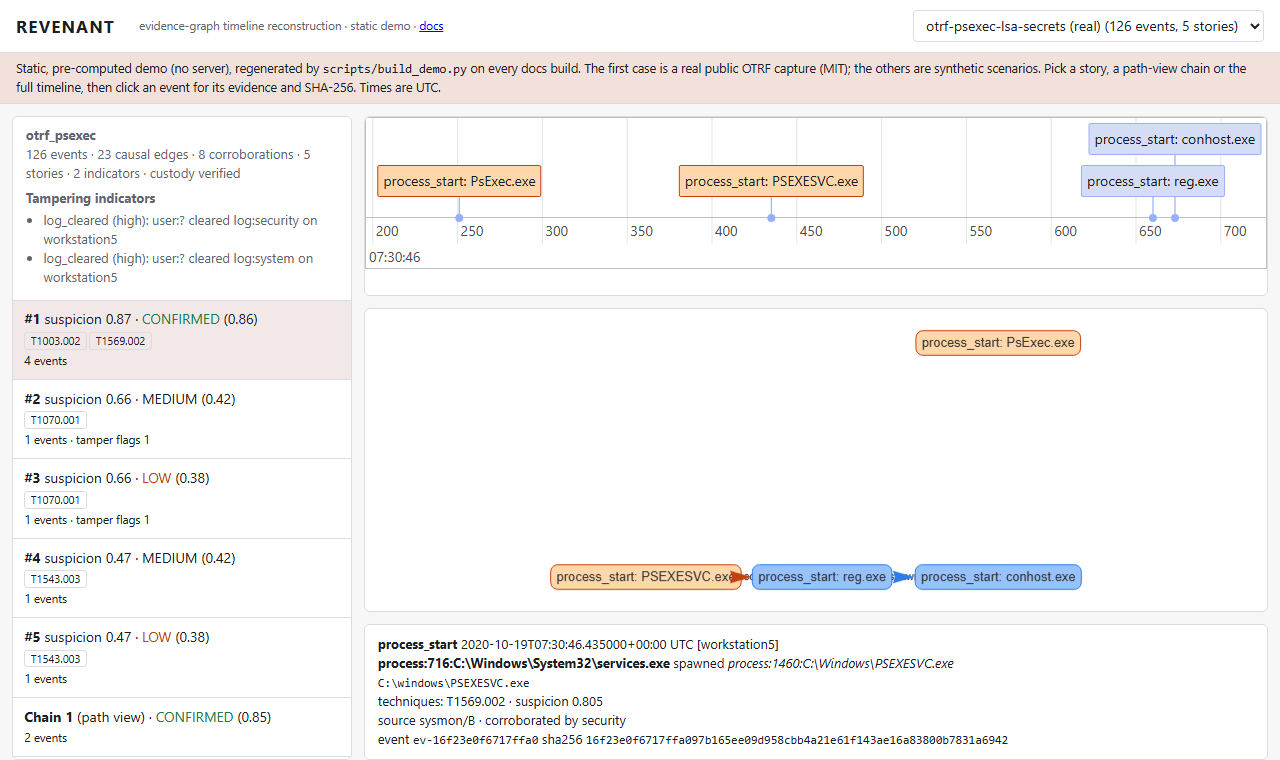
ev-ae581d6f… |
07:30:46.251 | Sysmon 1 | cmd.exe → PsExec.exe -accepteula -s reg save HKLM\security\policy\secrets … |
ev-16f23e0f… |
07:30:46.435 | Sysmon 1 | services.exe → PSEXESVC.exe |
ev-25f1b14e… |
07:30:46.660 | Sysmon 1 | PSEXESVC.exe → reg.exe |
ev-e8f40d81… |
07:30:46.673 | Sysmon 1 | reg.exe → conhost.exe |
3. Fusion
Each Sysmon 1 process start has a Security 4688 twin for the same process. Fusion merges the
pair: the Sysmon record stays, the 4688 record is marked shadowed (so rules never link
through it twice) and becomes a corroboration. This capture has 8 such corroborations;
the four events above are each corroborated by security.
4. Causal rules
The indexed rule engine (ADR 0002) adds 23 typed edges. Here the Sysmon GUIDs are present,
so the GUID rules fire: services.exe → PSEXESVC.exe → reg.exe → conhost.exe are linked by
guid_process_spawn (hand-set confidence 0.97). Without GUIDs (Security 4688 only, plaso,
memory) the same links come from host + PID + image + time rules whose confidences are
calibrated against GUID truth (see Evaluation).
5. Stories and ATT&CK
The graph is cut into incident stories (ADR 0004) and each event is scored by ATT&CK
heuristics and per-case rarity. The top story, story-a65f65fb66, carries
T1003.002 (LSA secrets via reg save) and T1569.002 (PsExec service), suspicion 0.87.
6. Confidence
Story confidence is a documented, hand-weighted sum (not a calibrated probability):
| term | weight | value |
|---|---|---|
| source reliability (Admiralty-style; Sysmon = B) | 0.3 | 0.85 |
| cross-artefact corroboration | 0.3 | 0.70 |
| temporal fit | 0.2 | 1.00 |
| edge strength (mean edge confidence) | 0.2 | 0.97 |
| tamper penalty | × | 1.00 |
0.3·0.85 + 0.3·0.70 + 0.2·1.00 + 0.2·0.97 = 0.86 → CONFIRMED (cut-off 0.85).
7. Report and custody
The report cites every claim with its event id and hash, lists the two log_cleared
indicators (the dataset author cleared the Security and System logs before recording) and
ends with the custody head. Persist and verify it (each case gets its own store: an
existing store holding another case's ledger is refused, and then no report is written):
revenant analyze tests/fixtures/otrf_psexec_lsa_secrets.jsonl --ledger case.sqlite --out report.md
revenant verify case.sqlite --expect-count 129 --expect-head <"Ledger head" from the report>
The same case is the default in the live demo: