THROUGHLINE
One evidence-first security knowledge graph that thirteen separate tools write into, so "what happened, how did it start, who did it, and how sure are we?" becomes a single query with a cited, confidence-graded answer.
Contribution: every engine's conclusion becomes a reliability-graded claim in one graph, and only independent engines are fused (noisy-OR over the best claim of each engine), with UNKNOWN as a competing attribution hypothesis. On public data this ranks the emulated technique first more often than the best single engine or an unfused union (hit@1 0.37 vs 0.26 for Sigma alone, +0.11 [0.05, 0.18], 97 real attack captures) and makes confident attributions right more often without adding confident errors (19.2% vs 13.0%, exact McNemar p = 0.0003, 448 leakage-controlled cases). The ablation isolates which part of the evidence model carries the gain.
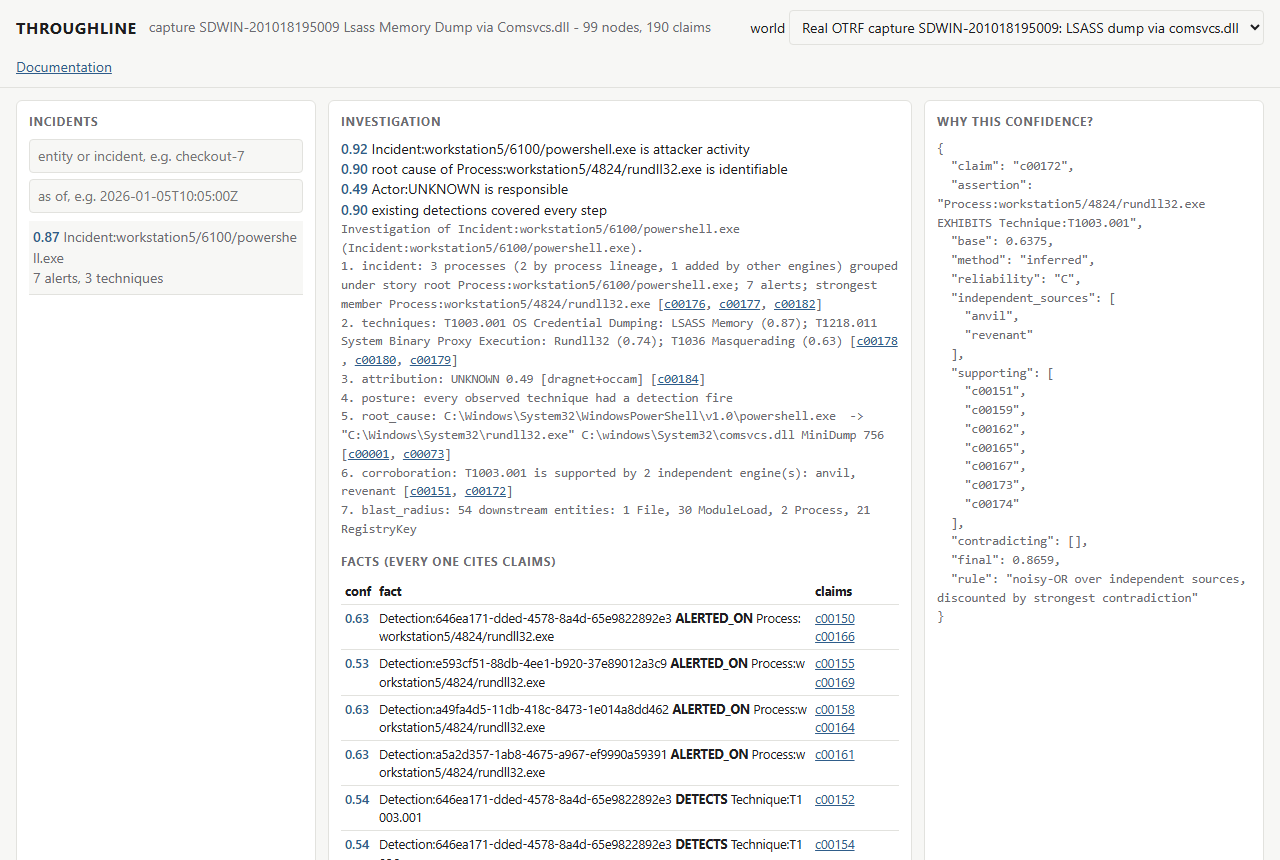
- Try it: the live console,
pip installor a container. - How it works: one real capture followed from raw event to cited answer.
- Evaluation: methodology, every result with its interval, what did not work.
- Reproduce: exact commands, expected numbers, runtimes.
Try it in 60 seconds
- In the browser: the live console opens on a real OTRF capture (LSASS dumped through
comsvcs.dll) run through every engine. Click a claim id to see how its confidence was computed. - On your machine (Python 3.11+):
pip install "throughline @ git+https://github.com/rakshit-737/throughline-security-knowledge-graph" throughline demo # synthetic supply-chain intrusion, a cited root-cause chain in about a second - In a container:
docker run --rm -p 127.0.0.1:8000:8000 ghcr.io/rakshit-737/throughline-security-knowledge-graph:latest, then open the console link it logs.
Headline results
| question | THROUGHLINE | best single engine / baseline |
|---|---|---|
| Emulated technique is the top claim (hit@1, 97 OTRF captures, ties in expectation) | 0.372 [0.288, 0.462] | Sigma alone 0.259 [0.201, 0.324] |
| Calibrated Brier on one shared set of 785 claims | 0.111 | Sigma alone 0.123 (difference -0.013 [-0.020, -0.006]) |
| Confident attribution that is right (448 leave-report-out cases) | 19.2%, 0.7% confidently wrong | DRAGNET 13.0%, OCCAM 13.2% |
| Lateral movement stitched on the APT29 evaluation (days 1 + 2) | 3 of 3 true host pairs, 0 false | 1.0.0: 3 true of 6 joined pairs |
| Technique ranking vs the APT29 emulation plan (precision@10, day 1 / day 2) | 0.40 / 0.33 | Sigma alone 0.33 / 0.22 |
What does not work is measured on the same pages: incident grouping adds nothing to technique ranking, incident prioritisation is no better than Sigma severity, the 15.8x alert compression is 2.2x against de-duplicated alerts, new malware families cannot be attributed from behaviour, and neither intel engine names APT29 even from the emulation plan's own techniques. See Evaluation and Limitations.
Safety
THROUGHLINE reasons about attacks; it performs none. Attack data is replayed from public logs, the simulation slot only emits a dry-run plan, CI only ever runs read-only administration commands on its own throwaway runner, and drafted detections stay unreviewed. See Security.