How it works
This page follows one real investigation from raw event to cited answer: the committed OTRF capture SDWIN-201018195009, 184 Windows event records recorded while an operator dumped LSASS memory through comsvcs.dll (ATT&CK T1003.001). Every output below is what the code prints on that capture (tests/fixtures/data, no download needed):
pip install -e ".[engines]"
python -m throughline capture SDWIN-201018195009 --data tests/fixtures/data
flowchart LR
  R["raw record"] --> N["normalizer<br/>canonical event + raw_ref"]
  N --> C["claim<br/>source, method, grade"]
  R --> E["engines<br/>ANVIL, REVENANT, ..."]
  E --> C2["engine claims"]
  C --> G[("graph")]
  C2 --> G
  G --> F["confidence<br/>noisy-OR over independent sources"]
  G --> I["correlation<br/>incidents + stitching"]
  I --> A["attribution, posture, plan"]
  A --> V["investigator<br/>cited report"]
1. A raw record becomes a canonical event and a claim
The Windows connector reads the record exactly as OTRF published it (Sysmon event 1, a process creation):
{
 "Channel": "Microsoft-Windows-Sysmon/Operational", "EventID": 1, "Hostname": "WORKSTATION5",
 "UtcTime": "2020-10-18 23:50:05.910", "ProcessId": "4824",
 "Image": "C:\\Windows\\System32\\rundll32.exe",
 "CommandLine": "\"C:\\Windows\\System32\\rundll32.exe\" C:\\windows\\System32\\comsvcs.dll MiniDump 756 C:\\Users\\wardog\\AppData\\Local\\Temp\\lsass-comsvcs.dmp full",
 "ParentProcessId": "6100",
 "ParentImage": "C:\\Windows\\System32\\WindowsPowerShell\\v1.0\\powershell.exe"
}
The normalizer validates it against the frozen contracts, caps and cleans the fields, and hashes the raw record (raw_ref) so the claim can always be traced back to the bytes it came from:
{
 "actor_type": "Process", "actor_id": "workstation5/6100/powershell.exe",
 "action": "SPAWNED",
 "object_type": "Process", "object_id": "workstation5/4824/rundll32.exe",
 "layer": "runtime", "source": "windows", "method": "observed", "reliability": "B",
 "ts": "2020-10-18T23:50:05.910Z",
 "raw_ref": "raw://windows/7f7afdb386588cb726a223a7ad06c8deb46faf627789000775f3c8a02ac1620c"
}
In the graph this is one claim: Process:workstation5/6100/powershell.exe SPAWNED Process:workstation5/4824/rundll32.exe. Its base confidence is the method prior times the source's Admiralty reliability weight: observed (0.9) x grade B (0.9) = 0.81 (ADR-0003). Raw records can also be kept in the append-only event store, whose hash-chained ledger store verify checks.
2. Engines add their own claims
Engines read the raw records or the graph and write only claims (the frozen engine protocol, ADR-0001):
- ANVIL matches its 2,410 compiled SigmaHQ Windows rules (the fixture carries five of them). Each hit is a
Detection ALERTED_ON Processclaim plusProcess EXHIBITS Techniquefor each ATT&CK tag of the rule; the rule's level becomes the reliability grade (critical A ... informational E). Here 7 alerts fire onrundll32.exe. - REVENANT builds its own provenance graph and scores events with ATT&CK heuristics; its tags are claims from a second, independent source (
revenant), with the heuristic's weight as the engine's own score. - ROOTLINE reconstructs incidents from a pivot, DRAGNET and OCCAM attribute them, VANTAGE checks what should have fired, GAUNTLET plans re-emulation of what was missed. On this capture ANVIL writes 21 claims, REVENANT 5, correlation 5, ROOTLINE 3, DRAGNET and OCCAM one each and VANTAGE 5 (GAUNTLET writes a dry-run plan, not claims); the graph holds 99 nodes and 190 claims.
3. Confidence: noisy-OR over independent sources
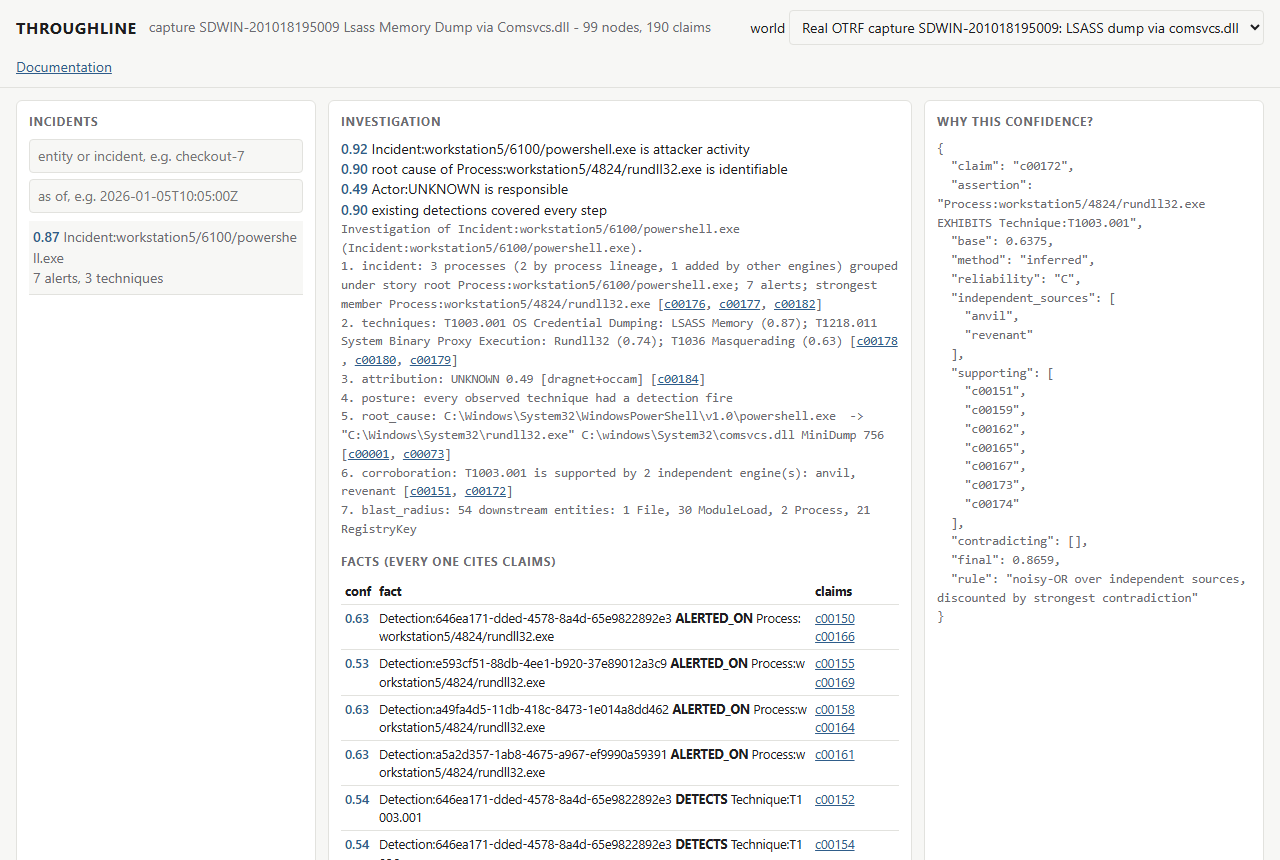
Several claims now support Process:workstation5/4824/rundll32.exe EXHIBITS Technique:T1003.001. The confidence engine takes the best claim of each independent source (twenty overlapping Sigma rules still count as one source, anvil) and combines them by noisy-OR, discounted by the strongest contradicting claim. GET /claims/c00172/explain (or a click in the console) shows the arithmetic:
{
  "claim": "c00172",
  "assertion": "Process:workstation5/4824/rundll32.exe EXHIBITS Technique:T1003.001",
  "base": 0.6375,
  "method": "inferred",
  "reliability": "C",
  "independent_sources": ["anvil", "revenant"],
  "supporting": ["c00151", "c00159", "c00162", "c00165", "c00167", "c00173", "c00174"],
  "contradicting": [],
  "final": 0.8659,
  "rule": "noisy-OR over independent sources, discounted by strongest contradiction"
}
REVENANT's heuristic weight 0.85 x grade C (0.75) = 0.6375; ANVIL's best rule is 0.63; together 1 - (1 - 0.6375)(1 - 0.63) = 0.8659. This independence rule is ablation A2 on the Evaluation page.
4. Correlation: incidents and fused technique confidence
Every process that carries a technique claim or an alert is a signal. Signals are grouped by their story root: walk SPAWNED parents until the parent is a session or service boundary process (explorer.exe, services.exe, wmiprvse.exe, ...). Here the root is powershell.exe (pid 6100), so the incident is Incident:workstation5/6100/powershell.exe with 3 member processes.
For each technique, the incident takes the best claim of each independent engine across all its members and combines them by noisy-OR: T1003.001 0.87 (ANVIL + REVENANT), T1218.011 0.74, T1036 0.63. Those roll-ups are Incident EXHIBITS Technique claims that cite the member claims (they are not re-counted).
Incidents on different hosts are stitched into one cluster when they share a rare remote destination contacted by non-system processes (not a domain controller's Kerberos port, not localhost), or when an admin-port connection from host A is followed by an incident on host B that starts under a remote-execution service. On the APT29 evaluation this joins exactly the evaluation's lateral movement, e.g. lateral scranton->nashua psexec64.exe 10.0.1.6:135.
5. Calibration
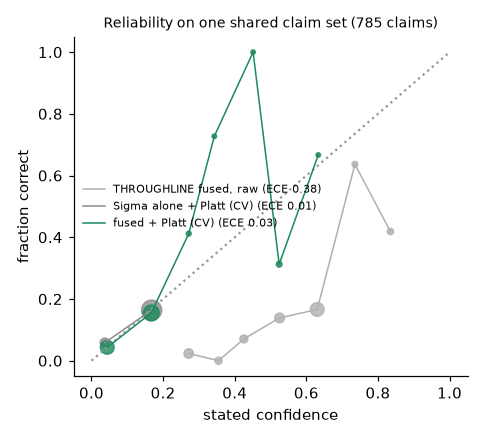
Raw confidence is a good ranking score but not a probability: across 97 captures, raw fused confidence is over-confident (ECE 0.38). A Platt map fitted on those captures, p = sigmoid(1.513 * logit(conf) - 2.264), ships in the package; incidents report both numbers. The 0.87 above becomes a calibrated 0.64: on emulated-attack captures, about two in three technique claims that confident are the labelled technique (most of the rest are genuine but incidental behaviour).
6. Attribution with UNKNOWN as a hypothesis
DRAGNET and OCCAM each read the incident's techniques and the ATT&CK software tags of the rules that fired, and each writes one Incident ATTRIBUTED_TO Actor claim, or Actor:UNKNOWN when it abstains or suspects a false flag. ATTRIBUTED_TO is exclusive, so competing actors discount each other and agreement raises confidence (ADR-0008). Here both abstain: UNKNOWN 0.49 [dragnet+occam]. Three LSASS-dumping techniques are not enough evidence to name anyone, and the platform says so.
7. The investigator's cited report
The investigator is bounded, deterministic and read-only: a fixed sequence of graph queries, every finding citing claim ids.
Investigation of Incident:workstation5/6100/powershell.exe (Incident:workstation5/6100/powershell.exe).
1. incident: 3 processes (2 by process lineage, 1 added by other engines) grouped under story root Process:workstation5/6100/powershell.exe; 7 alerts; strongest member Process:workstation5/4824/rundll32.exe [c00176, c00177, c00181]
2. techniques: T1003.001 OS Credential Dumping: LSASS Memory (0.87); T1218.011 System Binary Proxy Execution: Rundll32 (0.74); T1036 Masquerading (0.63) [c00178, c00180, c00179]
3. attribution: UNKNOWN 0.49 [dragnet+occam] [c00184]
4. posture: every observed technique had a detection fire
5. root_cause: C:\Windows\System32\WindowsPowerShell\v1.0\powershell.exe  -> "C:\Windows\System32\rundll32.exe" C:\windows\System32\comsvcs.dll MiniDump 756  [c00001, c00073]
6. corroboration: T1003.001 is supported by 2 independent engine(s): anvil, revenant [c00151, c00172]
7. blast_radius: 54 downstream entities: 1 File, 30 ModuleLoad, 2 Process, 21 RegistryKey
The same report is GET /investigator/{entity}; as_of= answers from the claims known at an earlier time.
8. When nothing fired: the feedback loop
If no engine claims the labelled technique, the capture is a detection gap. The loop keeps the command lines and script blocks that appear in no unrelated capture, asks ANVIL's drafter for Sigma rules, and accepts a draft only if it fires on its own capture and on zero events of every unrelated capture. Accepted drafts are re-validated in CI by re-running the benign behaviour they were mined from on a fresh Windows runner. They stay status: experimental, reviewed: false.